How to Sell Surplus Inventory: A Practical Guide to Selling Surplus MRO and Spare Parts

To sell surplus inventory from a manufacturing plant, start by cleaning up your MRO data so every part has a verified manufacturer part number, decide which parts you would not buy again today, value them against current market demand, and present them with condition, quantity and photos. Then pick the sales route that fits your goal: a direct buyout for speed, consignment to keep ownership while someone else sells, or a marketplace listing to reach industrial surplus buyers yourself. Specialist buyers of automation and MRO parts usually pay more and decide faster than general classifieds or auctions, because they know exactly what they are looking at.
Where Surplus MRO Inventory Comes From
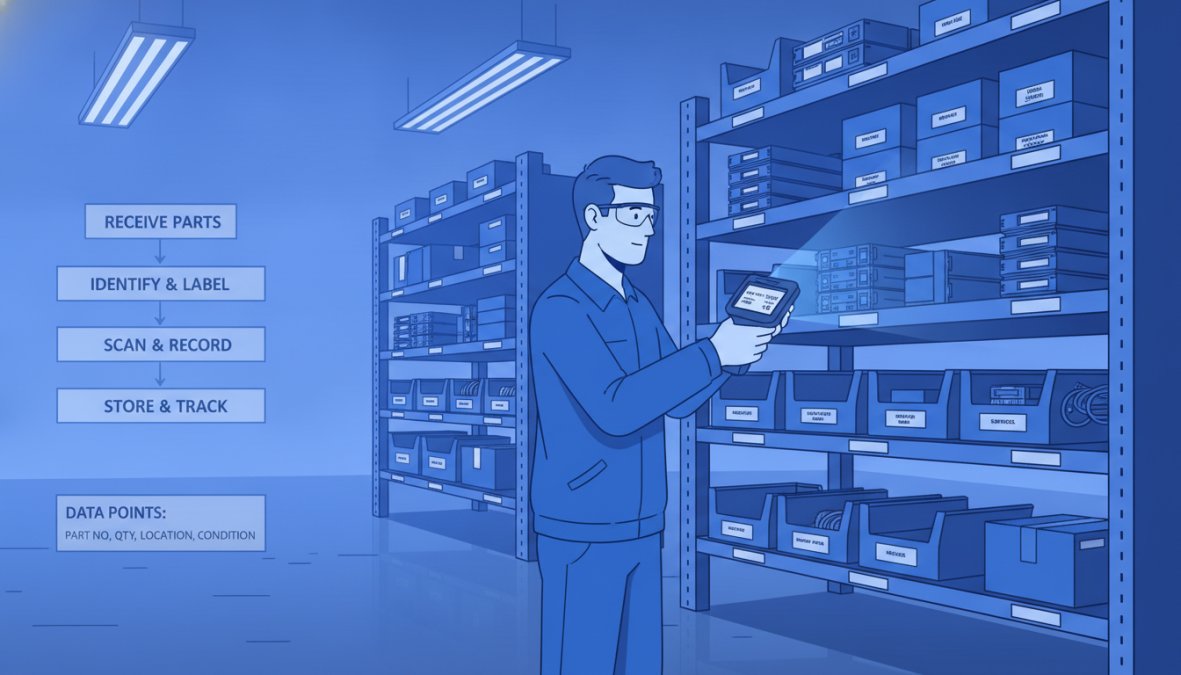
No plant sets out to build surplus stock. It accumulates as the plant changes faster than its storeroom:
- Minimum order quantities. Suppliers often require more units than a project needs, and the rest goes on the shelf.
- Cancelled or changed projects. Parts ordered for a line that was redesigned or never built.
- Line upgrades and retired machines. The spares for yesterday's equipment stay behind when the equipment leaves.
- "Just in case" buying. A long quoted lead time leads maintenance to double an order; later the part becomes easy to get, but the extra stock stays.
- Duplicate records. The same part held under two material IDs, for example once under the manufacturer part number and once under a type code or a successor part number, so the plant buys it again.
The typical result is the storeroom you probably know: three versions of the same contactor, boxes of modules from a line that no longer exists, and drives nobody has touched in years.
What Surplus Inventory Really Costs
Idle spare parts are not free just because they were paid for. They cost you in three ways:
- Carrying costs. Space, insurance, counting, audits and system upkeep. Industry estimates commonly put the yearly cost of holding a part at a sizeable share of its value, so over a few years you can pay for the part a second time without ever using it.
- Lost value. Automation parts lose resale value as their product generation ages and successor models arrive. The longer they sit, the less a buyer will pay.
- Operational friction. A bloated catalog makes the right part harder to find, causes wrong picks and duplicate purchases, and slows maintenance down.
The emotional objections are familiar: "we might need it someday", "what if that machine comes back", "we paid more than anyone will offer now". But your storeroom should support the plant you run today, not the one from five years ago. Recovering value sooner is responsible management, not a loss.
Step 1: Clean Up Your MRO Data First
You cannot sell what you cannot identify. Before you trim stock levels or contact buyers, standardize the catalog:
- Export the catalog and start with the highest-value items.
- Verify manufacturer names and part numbers. Map internal codes to the manufacturer part number (MPN). Buyers and their procurement systems search by MPN; without it your listing is invisible.
- Merge duplicates created by type codes, renamed parts and successor parts.
- Complete the attributes buyers search for: voltage, size, frame, configuration, firmware version.
- Link critical spares to the assets they support, so you know which parts must stay no matter how slowly they move.
A clean catalog pays off twice: it shows you what is really surplus, and it lets you check market availability and lead times before you decide how much safety stock you actually need. For the critical side of that decision, see our guide to identifying critical spare parts.
Step 2: Decide What Goes, and Where
Ask one question of every slow mover: would we buy this part again today? Flag non-movers, orphaned parts from finished projects and obsolete part families, then let engineering confirm what has to stay. Everything else takes one of four routes:
| Route | When it fits |
| Redeploy internally | Another plant or line uses the same part |
| Return to the vendor | The part is current and the supplier accepts returns |
| Sell | The part has market demand: new, unused, tested or still in production somewhere |
| Recycle responsibly | Damaged or worthless parts; industrial electronics belong in proper e-waste streams, not landfill |
Obsolete parts deserve special attention. Discontinued PLCs, drives and HMI panels that still run production lines elsewhere are often worth more than current parts, because their users cannot buy them new. Our guide to managing obsolete industrial spare parts covers the other side of that market.
Step 3: Value Your Surplus Parts
Surplus automation parts have no fixed book value. Price follows current supply and demand, and the same part number can be worth very different amounts to different buyers.
| Factor | Effect on value |
| Condition | New-in-box sells well above used; tested beats untested |
| Brand and product family | Widely installed brands attract more buyers |
| Obsolescence | Discontinued parts that are still in use can command a premium |
| Documentation | Datasheets, firmware versions and certificates raise offers |
| Quantity | Bulk lots attract distributors and brokers |
| Storage conditions | Humidity and poor packaging degrade electronics |
Two practical rules follow. First, timing matters: demand for a part drops once its successor is established, so start the surplus process before a line changeover, not years after it. Second, get more than one offer: a regional dealer and a broker with an open customer request for your exact part will quote very differently.
Step 4: Prepare Listings Buyers Trust
Buyers of industrial spare parts want certainty: is it genuine, what condition is it in, will it fit, and how fast will it arrive? Every listing should answer those questions up front:
- Manufacturer and exact part number, plus the successor part number if the part is discontinued
- Condition grade, using the scale surplus buyers use (below)
- Quantity and packaging
- Clear photos from several angles, including labels, connectors and terminals
- Known faults or cosmetic damage
- Firmware version for PLCs, drives and HMI panels
- Weight, dimensions and country of origin
Use standard condition grades. Most industrial surplus buyers grade on the same scale, and a listing that uses it is quoted faster:
| Grade | Meaning |
| New in box (NIB) | Original manufacturer packaging, never installed, documentation complete |
| New surplus | New and unused, but without original packaging or full documentation |
| Refurbished | Previously used, inspected and tested to the manufacturer's specification |
| Used, tested | Removed from service and confirmed working |
| Used, untested | Removed from service, function not verified |
Grade honestly. Buyers test on receipt, and a part that does not match its grade leads to a revised offer and a slower payment.
Group parts sensibly. A box of "miscellaneous automation parts" attracts bargain hunters. A coherent lot, such as one brand's drives or one family of pneumatic components, attracts specialists who know exactly what they need and pay accordingly.
Prepare controls before sale. Power-test PLC and HMI modules where you can, note firmware versions, remove proprietary programs and customer logic, photograph pins and connectors, and check backup batteries.
Who Buys Surplus MRO Inventory?
Surplus inventory buyers for industrial and automation parts fall into a few groups:
- Maintenance teams at other plants running the same equipment, especially legacy lines
- Independent distributors building stock of hard-to-find parts
- Brokers sourcing against specific customer requests
- Repair companies that need donor parts and exchange units
- Surplus specialists that buy whole lots outright
General marketplaces and auctions reach many people but few who understand a SINAMICS module or an SLC 500 card, so offers tend to be low and slow. Specialized platforms and networks for industrial automation connect you with buyers who trade these parts every day. Distributors and resellers can read how to sell more industrial automation parts online for the seller's side of that market.
Ways to Sell Surplus Stock Compared
| Option | Speed | Your effort | Return | Best for |
| Direct buyout | Fastest | Lowest | Lower per part, cash at once | Plant closures, warehouse moves, clearing whole lots |
| Consignment | Medium | Low | Higher; you keep ownership until sale | Valuable stock you want sold professionally |
| Marketplace listing | Medium | Medium | You set the price | Companies that want control, or anonymity |
| Internal bulletin boards, general classifieds | Slow | High | Usually lowest | Small, low-value items |
For a plant closure or a full line decommissioning, the same steps apply in compressed form: catalog by brand and category, set aside what other sites can reuse, and get a buyout offer for the bulk while high-value items go to consignment or listing. Our guide to industrial asset recovery covers larger equipment and whole-site recovery in more depth.
Getting a Quote and Getting Paid
To get a quote for surplus or obsolete industrial parts, send a spreadsheet with manufacturer, exact part number, quantity and condition grade for every line, plus photos of labels and nameplates. Buyers cannot price what they cannot identify, so lines without a part number slow the whole quote down. Then:
- Ask more than one buyer for any lot of real value. Competing quotes are normal in this market.
- Split premium parts from the rest. A buyer prices a mixed lot by its weakest items. Sell in-demand PLCs, drives and HMI panels individually, through consignment or a listing, and offer the remainder as one buyout lot.
- Agree freight before you ship. Some buyers cover shipping for accepted lots, others do not.
- Agree payment terms before you ship, especially for large lots, and know what happens if the buyer's inspection finds a part below its stated grade.
Storage, Shipping and Paperwork
Storage. Keep electronics in a dry, temperature-stable room, in original packaging or resealed anti-static bags. Store servo motors and drives so bearings are not loaded, and never stack heavy items on modules with circuit boards.
Shipping. Double-box heavy components, use ESD-safe packaging for every board and module, secure connectors with foam, add desiccant for humid destinations and label boxes with part numbers.
Paperwork. Confirm the parts are on your asset register and their disposal is authorized, keep purchase records for buyers who ask for provenance, and check export rules before selling abroad: some industrial control equipment falls under export controls, as the U.S. Bureau of Industry and Security compliance guidance explains. Disposals have tax consequences too; see the next section.
Tax and Accounting When You Sell Surplus
Selling, writing off or scrapping surplus changes your books, and the tax effect can shift what you actually keep. The rules differ by country and by how your company accounts for inventory and fixed assets, so treat the points below as questions for your finance team or tax advisor, not as tax advice:
- Fixed assets versus inventory. Machines, drives and robots that were capitalized and depreciated are fixed assets; spare parts held in the storeroom are usually inventory. The two are treated differently when they leave the business.
- Gains on depreciated assets. If you sell equipment for more than its remaining book value, the difference is generally taxable income, even when the price is far below what you originally paid. Fully depreciated equipment that still sells can therefore create a tax bill. Calculate it before you accept a large offer, not after.
- Write-downs of obsolete stock. Writing surplus inventory down to its market value usually reduces taxable profit, but tax authorities expect evidence: current market quotes, proof that a part is discontinued, or records of failed sales at the old price.
- Sell, donate or scrap. Each route has a different tax treatment and different paperwork. Scrapping gives you the least, because you lose both the sale proceeds and the chance to reuse the part.
- Timing. Spreading disposals over financial years, or matching them to a year with other losses, can change the net effect.
- Documentation. Keep bills of sale, buyer details, the asset register entries, condition records and, for scrapped items, destruction or recycling records.
A clean MRO catalog makes all of this easier, because every part has a verified part number, a quantity and a recorded value that you can match to the sale.
Managing Surplus Inventory So It Does Not Come Back
Surplus inventory is stock held beyond what demand needs over your planning horizon. Managing it well means acting on it early and fixing the purchasing habits that create it. A one-time cleanup decays within a year unless it becomes routine:
- No part enters the material master without a manufacturer, a validated part number and a stocking policy.
- Run a duplicate check monthly and review slow movers quarterly.
- Route agreed surplus to the next sales batch instead of letting it wait for a big cleanup.
- Set time-based steps in advance. Decide when a slow mover is offered internally, when it is listed for sale, and when it is bundled or sold as a lot, so nothing waits for a yearly decision.
- Build kits and sensible lots. Parts usually ordered together, or a full set of modules for one controller family, sell faster as a kit than one by one.
- Rank stock by consumption value (ABC analysis) and spend review time on the high-value items first.
- Reserve for obsolescence quarterly. Writing down ageing stock in small, regular steps keeps the books closer to reality than one large write-off at year end.
- Tie purchasing rules to consumption. Large orders, minimum order quantities and volume discounts should be checked against what the plant actually uses.
- Before reordering, ask whether the part is still essential, whether a supplier or repair company could deliver it quickly, and whether lead times have improved since the last panic order.
Selling surplus also has an environmental side: every part that goes back into service displaces a new one and stays out of the waste stream, which many companies now report as part of their circular economy efforts.
How Automa.Net Helps You Sell Surplus Inventory
Automa.Net specializes in surplus industrial automation and MRO parts and works with sellers in several ways, depending on whether you want speed, value or discretion:
- Data cleanup: help standardizing and enriching your MRO data so parts can be identified, valued and found by buyers.
- Direct buyout: an offer for your parts based on market demand and condition, for quick liquidation.
- Consignment (Fulfilment Center program): you keep ownership while Automa.Net handles storage, listing and logistics.
- Anonymous marketplace listings: reach industrial surplus buyers without disclosing your company name, with your own prices and conditions.
- Reporting: documented transactions for finance, procurement and audits.
One example from Automa.Net's work: Orex Rotomoulding, a rotational moulding company, sold surplus parts worth €8,000 within the first week, with Automa.Net photographing, listing, pricing and shipping the parts.
Start with Sell your surplus stock, or read how Automa.Net buys overstock. Maintenance teams can also see how Automa.Net supports MRO inventory optimization.
Frequently Asked Questions
How do I sell surplus inventory from a manufacturing plant?
Clean up the catalog so each part has a verified manufacturer part number, decide which parts you would not buy again, value them against current demand and condition, and list them with photos, condition grades and quantities. Then choose a direct buyout, consignment or a marketplace listing, depending on how fast you need the cash and how much effort you can spend.
Who buys excess MRO inventory from manufacturing facilities?
Maintenance teams running the same equipment, independent distributors, brokers with customer requests, repair companies and surplus specialists. Platforms dedicated to industrial automation parts reach these buyers more directly than general classifieds or auctions.
What surplus spare parts sell best?
PLCs and I/O modules, HMI panels, servo motors and drives, frequency converters, sensors and industrial power supplies from widely installed brands, especially new-in-box or tested units with documentation. Discontinued parts that still run production lines often sell at a premium.
How do I value surplus automation parts?
Check what the same part number currently sells for, adjust for condition, documentation, quantity and obsolescence status, and collect offers from more than one buyer. There is no fixed book value: the market price is what informed buyers will pay now.
Is a buyout or consignment better?
A buyout is faster and gives you cash at once, which suits plant closures and warehouse moves. Consignment usually returns more for valuable parts because they are sold individually at market prices, but you wait for each sale.
Does selling surplus inventory affect taxes?
Usually, yes. Selling depreciated equipment above its book value generally creates taxable income, while writing obsolete stock down to market value usually reduces taxable profit if you can document it. Rules differ by country, so involve your finance team or tax advisor before a large disposal.
How do I stop surplus from building up again?
Make data quality a gate for every new part, review slow movers every quarter, sell surplus in small regular batches, and use current lead times and availability to set safety stock instead of buying "just in case".
Other Posts

Find Automation Parts Supplier: Never Face Project Delays Again
Find automation parts fast with verified suppliers. Compare prices, avoid delays, and get obsolete components from trusted automation parts suppliers ...
Read More →
Nexus™ Solution by WIN SOURCE
Discover how WIN SOURCE’s Nexus™ Solution bridges design and supply with real-time intelligence, predictive insights, and smarter sourcing.
Read More →
AutomaPAY – Payment Solution for Industrial Automation Transactions
Discover AutomaPAY, the secure industrial procurement payment solution on Automa.Net. Enjoy instant trade credit, risk-free transactions, and flexibl...
Read More →