Spare Parts Procurement Software: 2026 Reviews and Must-Have Features

Spare parts procurement software helps maintenance and purchasing teams find, buy and manage industrial spare parts: parts search across suppliers, RFQs, approvals, inventory and ERP integration. No single tool does all of it well. Sourcing marketplaces, MRO data platforms, CMMS tools and source-to-pay suites each solve a different problem, and choosing the wrong category costs more than choosing the wrong vendor. Below we review twelve platforms, list the features worth paying for, and show how to pick the right fit for your scale.
How We Evaluated These Tools
Spare parts sourcing software ranges from standalone parts identification engines to fully integrated source-to-pay suites. Our criteria reflect the decisions procurement and maintenance teams actually face:
- Parts search and identification accuracy: can the platform find a part by number, description or image across multiple suppliers?
- ERP and CMMS integration depth: does it connect natively to SAP, IBM Maximo or your existing systems, or only through custom API work?
- Inventory optimisation: does it support safety stock calculation, demand forecasting and reorder automation?
- Supplier network quality: are suppliers verified, and how broad is geographic coverage?
- Data governance: how does it handle duplicate SKUs, unstructured MRO data and obsolescence?
- Total cost of ownership: licensing model, implementation effort and time to value.
- Scalability: does it serve a 50-person plant as well as a 50-site enterprise?
We weighted sourcing speed and integration depth most heavily, because operational downtime is where the financial pain is sharpest.
The Best Spare Parts Procurement Software Reviewed

The platforms below cover the full spectrum, from single-site maintenance teams to global multi-plant enterprises.
1. Automa.Net, Best for Real-Time Global Sourcing
Automa.Net suits procurement teams that need immediate visibility across a global supplier network without building that network themselves. The platform connects buyers to over 700 verified suppliers and more than 14.8 million in-stock products, with intelligent part search and data matching that cuts manual cross-referencing. Its search indexes over 36 million automation parts, and market analytics show parts lifecycle and current market value, which matters when sourcing components for legacy equipment no longer in production.
BOM Search checks a whole bill of materials at once, the Request Board sends a requirement to verified suppliers when a search finds nothing, and the WatchList alerts you when availability of a critical part changes. RFQs and orders live in one dashboard, and surplus stock trading is built in for operations carrying excess inventory they would otherwise write off.
Pros: real-time inventory from hundreds of suppliers; part search and data matching; verified supplier network; integrated RFQ and order management; market analytics for lifecycle and value
Cons: pricing is not publicly listed; best suited for industrial automation parts rather than broader MRO categories
Best ForManufacturing and maintenance teams sourcing industrial automation and electronic parts who need real-time global supply visibility without managing many supplier relationships by hand.
2. SPARETECH, Best for MRO Data Governance and Deduplication
Most MRO inventory problems are data problems, not sourcing problems. SPARETECH harmonises spare parts data across ERPs, eliminates duplicate SKUs and manages obsolescence across multi-site operations. It integrates with SAP and IBM Maximo and uses a manufacturer-verified reference database. For groups running the same part under several descriptions across plants, it delivers measurable inventory reduction.
The limitation: SPARETECH is a data governance tool first. End-to-end procurement needs a sourcing platform alongside it.
Pros: faster creation of clean inventory records; manufacturer-verified reference data; strong ERP integration
Cons: focused on data governance rather than full-cycle procurement
3. Verusen, Best for Inventory Intelligence Without a Data Cleanse
Verusen takes a different route to the same data problem: instead of a long cleansing project first, it works with existing, unrefined ERP data, harmonises it with AI and surfaces duplicate materials, stock held at other sites and materials at risk of running out. Insights arrive in weeks rather than after a multi-year data project. For a side-by-side view, see our Verusen vs SPARETECH comparison.
Pros: fast time to insight; works on messy data; multi-site stock visibility
Cons: an intelligence layer, not a sourcing or purchasing tool
4. Partium, Best for AI-Powered Parts Identification
Maintenance teams lose a lot of time just identifying which part they need. Partium uses visual and text search across a manufacturer-agnostic parts database and links each part to the correct manufacturer record before an order is placed. For aging equipment with incomplete documentation, its visual search is one of the most practical options available.
Pros: less time on manual identification; better procurement accuracy; manufacturer-agnostic
Cons: needs integration with existing systems to be fully effective
5. Keelvar, Best for Automated Sourcing Events
Keelvar automates the sourcing process itself: gathering requirements, selecting suppliers, running bid events and recommending awards, with an optimiser that weighs cost, risk and supplier capacity. It fits MRO teams buying high-volume, straightforward categories such as consumables or safety gear, and supports fast spot buys for urgent needs.
Pros: automates repetitive sourcing events; scenario-based award optimisation; quick spot quotes
Cons: built for sourcing events, not parts identification or inventory management
6. ThroughPut AI, Best for Demand Forecasting in Asset-Intensive Industries
In mining, oil and gas or automotive, parts consumption follows equipment behaviour, not the calendar. ThroughPut AI uses IoT and ERP data to trigger procurement before a stockout becomes a shutdown, synchronises ERP, MRO and IoT systems and segments inventory in detail. Implementation is complex, but where unplanned downtime is very expensive it can justify the effort.
Pros: highly automated; focus on operational resilience; IoT-driven procurement triggers
Cons: complex implementation; not suited to simpler environments
Watch OutThroughPut AI's value depends entirely on the quality of your IoT and ERP data feeds. Teams with inconsistent data will spend more time on integration than on optimisation. Audit data quality before committing.
7. Verdantis, Best for Enterprise MRO Inventory Optimisation
Verdantis targets the problem underneath most enterprise MRO failures: unstructured, inconsistent data that makes optimisation impossible. It extracts and standardises unstructured data, applies criticality assessments and drives inventory optimisation enterprise-wide. Overkill for a single-site plant; for a large multi-site enterprise with a big MRO inventory, it can pay for itself.
Pros: strong data cleansing and governance; lower long-term MRO spend through better data
Cons: high barrier to entry for smaller organisations
8. Makula CMMS, Best for Mid-Market Manufacturing on a Budget
Makula publishes its per-user pricing, which is rare in industrial software and useful for cost-sensitive plants. It covers real-time inventory tracking, automated low-stock alerts and parts usage tied to work orders, with an AI maintenance copilot for troubleshooting and documentation. It does not offer the enterprise governance of Verdantis or SPARETECH, an acceptable trade-off for mid-market operations.
Pros: transparent pricing; easy to implement; automated reorder notifications
Cons: may lack governance features for complex multi-site operations
9. Fabrico, Best for Work Order Reconciliation and Inventory Accuracy
The gap between parts consumed and parts recorded is one of the most persistent problems in maintenance. Fabrico closes it with QR-code parts checkout inside the work order, so technicians log consumption at the point of use. Min/max automation handles critical spare reordering, and asset-part linking identifies obsolete spares before they become write-offs.
Pros: enforces inventory logging; clear maintenance cost per asset; QR-based checkout
Cons: primarily a CMMS; complex sourcing needs additional tools
10. JAGGAER, Best for Enterprise Source-to-Pay Procurement
JAGGAER is a full source-to-pay suite for enterprises with complex global supplier relationships: automated procurement workflows, supplier performance monitoring, contract management and spend analytics. It is overkill if you only need to manage spare parts inventory; its depth is built for strategic sourcing across many suppliers and categories.
Pros: deep ERP integration; comprehensive strategic sourcing; supplier performance monitoring
Cons: overkill for simple spare parts management; significant implementation investment
11. Partscloud, Best for Machine Manufacturers Managing After-Sales Service
Machine manufacturers manage aftermarket inventory for machines they have sold, not machines they run. Partscloud is built for that: ERP-integrated spare parts planning, automated procurement workflows and dead stock reduction. Its niche focus is also its limit: it is not designed for end-user maintenance teams.
Pros: fast ERP integration; tailored to industrial service; dead stock reduction
Cons: focused on OEMs rather than maintenance teams
12. Claimlane, Best for Warranty-Driven Spare Parts Workflows
Claimlane covers a workflow general MRO platforms ignore: warranty claims, returns and the spare parts they consume, with demand forecasting for warranty parts. Valuable for brands handling many warranty repairs; the wrong tool for general maintenance inventory.
Pros: strong returns and warranty workflows
Cons: not designed for general MRO or maintenance inventory
Must-Have Procurement Software Features
Whatever category you buy, these are the capabilities that prevent quiet failures: duplicate orders, unapproved suppliers, invoices that do not match orders, and spend nobody reports.
Parts Data Built for Technical Components
Industrial parts carry attributes generic purchasing tools do not handle: manufacturer part numbers, cross-references, lifecycle status and interchangeability. A component-aware platform knows that a module has approved substitutes, which of them are end-of-life, and which one a supplier has in stock today.
Requisitions and Approval Routing
Requesters should submit needs through a guided form or catalogue, and the system should route them by spend threshold, department, category or supplier. Check for:
- Multi-level approval chains with conditional logic, and parallel approvals.
- Delegation rules when an approver is absent.
- A budget check at the moment of submission.
- Mobile approvals with full context, so field engineers are not left waiting.
- An audit trail of every approval with user and timestamp.
Build workflows around your purchasing policy, not around today's manual process.
Three-Way Matching and Invoice Processing
Three-way matching compares purchase order, goods receipt and invoice before payment, which stops overpayments, duplicate payments and fraudulent invoices. Look for tolerance rules for small variances, OCR for PDF invoices, handling of partial deliveries and backorders, and an ERP link so the system knows when parts actually arrived.
Supplier Portal and Vendor Management
A supplier portal lets vendors submit quotes, confirm orders and upload invoices themselves instead of by email. Vendor management should include qualification workflows, scorecards for on-time delivery and fill rate, and screening against sanctions lists and required certifications before a supplier joins the approved list.
Spend Analytics and Lifecycle Data
Dashboards should show committed spend, actuals and budget variance by department, category and supplier. For automation components, analytics should extend to lifecycle data: knowing a part is approaching end-of-life before the supplier discontinues it gives time to qualify an alternative. Our guide to spare parts obsolescence management covers the process.
Automated Reorders and API Access
If you want critical spares reordered automatically from your procurement system, the platform needs reorder rules tied to lead time and criticality, plus an API or webhooks to exchange stock, price and order data with your ERP. Ask vendors to show the API documentation, not just a slide.
ERP Integration and the Procure-to-Pay Lifecycle
Integration is a prerequisite, not a feature. Procurement software that does not connect to your existing systems creates another data silo.
The procure-to-pay lifecycle runs from need identification through requisition and approval, supplier selection and RFQ, purchase order, goods receipt, invoice matching and payment. Practical ERP integration pushes approved orders into the ERP, pulls goods receipts back to trigger invoice matching, and keeps vendor master data in sync. Treat it as ongoing work: ERP updates and new modules break connectors that nobody maintains. Platforms with pre-built connectors for SAP, Oracle or Microsoft Dynamics reduce that burden compared with custom builds.
Contract lifecycle management (CLM) closes another gap: when a requisition comes in, the system checks for a contract with a preferred supplier and applies the contracted price. Without that link, buyers ignore contracts, which is how maverick spending starts. According to Gartner's procurement technology research, organisations using best-of-breed procurement applications alongside their ERP see stronger adoption than those relying on ERP modules alone.
Pro TipFor industrial teams, the most effective stack often combines a specialised component sourcing platform for upstream parts discovery with a procure-to-pay platform for downstream approvals and payment. Trying to do both with one general-purpose tool usually means doing neither well.
Spare Parts Sourcing Challenges Every Buyer Should Know
Choosing software starts with knowing which problem you are solving. The two most common failures are operational, not technical.
Stockouts, Lead Times and Downtime
Unplanned downtime most often traces back to a stockout of a critical part with a long lead time. Holding more inventory is not the answer; safety stock must match real lead times, criticality and consumption. ThroughPut AI and Verdantis automate this calibration; simpler tools like Makula handle it with min/max rules. See also our guide on how to calculate spare parts safety stock.
Pro TipClassify parts by criticality before setting safety stock in any platform. Three tiers (critical, important, standard) let you apply tight reorder rules where they matter without inflating inventory everywhere.
Duplicate SKUs and Unstructured MRO Data
A typical multi-site pattern: the same bearing exists under four descriptions, three part numbers and two units of measure. Nobody knows the true stock level, procurement creates duplicate orders and carrying costs climb. Clean MRO data is the foundation every other optimisation depends on; without it, forecasting and automated reordering produce unreliable results.
How to Implement Spare Parts Procurement Software
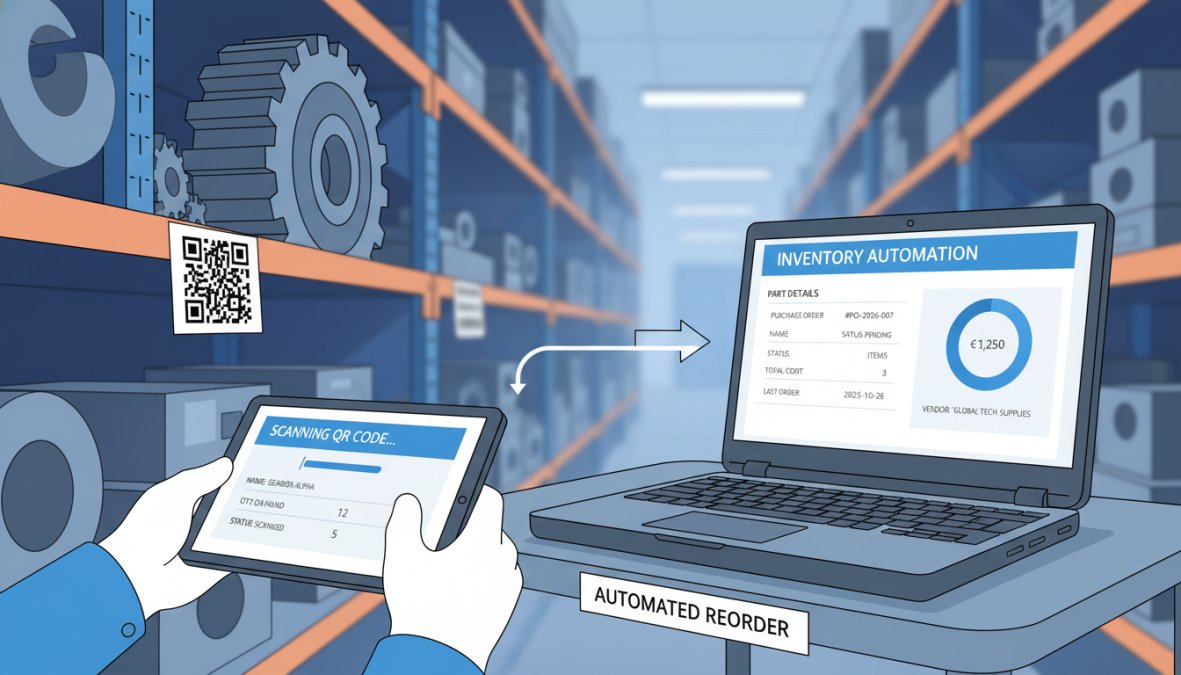
Implementation moves from visibility to integration to automation. Skipping stages is the most common mistake.
Step 1: Audit Your Inventory and Data
Export your parts list from the ERP or CMMS and sort it into three groups: active parts with accurate stock, active parts with unreliable data, and inactive or obsolete parts taking up space. Clean the vendor master and part numbers before migration so bad records do not move into the new system.
Step 2: Connect Your CMMS or ERP
Start with read-only synchronisation before enabling write-back. That lets you validate parts, stock and supplier data mapping without risking your production system. Confirm integration depth before you sign, not after.
Step 3: Pilot One Category
Run one category, such as automation spare parts, through the new system while the old process stays as a fallback. Measure cycle time and exception rates, then expand by category or department, each phase with its own success metrics.
Step 4: Set Safety Stock and Automate Reorders
With clean data flowing, configure reorder triggers by lead time, criticality and consumption. Start with min/max rules and move to AI-driven forecasting as data accumulates.
Step 5: Drive Adoption
Software fails when buyers work around it, usually because it is slower than their old process. Involve operations, finance and reliability engineering from the start, shadow buyers before configuring anything, pick two or three internal champions, share quick wins, and set a firm cutoff date for the old process. After go-live, review supplier data, approval workflows, integration health and user access every quarter.
Security, Compliance and Total Cost of Ownership
A procurement platform holds supplier financial data, contract terms and payment details. Before signing, verify:
- SOC 2 Type II certification, an independent audit of security controls.
- GDPR compliance for European supplier data.
- Role-based access control, so buyers see only what their role needs.
- Encryption in transit and at rest.
- Single sign-on, so offboarded staff lose access automatically.
The licence is rarely the largest cost. Implementation services, data migration, integration and training often exceed the first year's subscription for enterprise platforms. Model three years:
- Year 1: licence + implementation + integration + training
- Year 2: licence + support + optimisation
- Year 3: licence + expansion to more sites or users
For platforms without published pricing, ask for a three-year cost projection during the sales process. A vendor unwilling to provide one is a red flag.
Key TakeawayTotal cost of ownership is typically a multiple of the annual licence once implementation, integration and training are included. Build a three-year model before comparing platforms on price.
Choosing the Right Software for Your Scale
The most important criterion is fit between platform complexity and operational complexity. Overbuying creates implementation debt; underbuying creates gaps that surface at the worst moment.
Small and mid-market operations (single site, a few hundred employees at most) need fast time to value, transparent pricing and low implementation overhead. Makula and Fabrico are the strongest options here.
Enterprises (multi-site, complex supplier relationships, high MRO spend) need data governance, ERP integration depth and autonomous optimisation: SPARETECH, Verusen, Verdantis, ThroughPut AI and JAGGAER are built for this. A common mistake is buying enterprise software before the data infrastructure exists to support it.
Sourcing speed and supplier access is a separate need at any scale; a marketplace such as Automa.Net covers it alongside whichever system runs inventory and approvals. For the procurement process around the software, see our spare parts procurement guide.
Circular economy practices are an emerging selection factor too: surplus parts trading, refurbished components and obsolescence management. Automa.Net's surplus trading lets buyers source from excess inventory rather than new production; SPARETECH and Verdantis address obsolescence.
Conclusion
Choosing spare parts procurement software comes down to one question: what is your actual bottleneck? If it is sourcing speed and supplier access, a marketplace like Automa.Net addresses it directly. If it is data quality, SPARETECH, Verusen or Verdantis belong at the top of the list. If it is affordable maintenance and inventory control, Makula or Fabrico are the practical choices. Audit your data first, check the must-have features, model three years of cost, and match platform complexity to your scale.
Frequently Asked Questions
What is spare parts procurement software?
Spare parts procurement software is a digital platform that helps maintenance, procurement and operations teams find, manage and purchase spare parts for industrial equipment. Depending on the category, it provides supplier networks and parts search, RFQ and approval workflows, inventory and reorder management, and ERP integration. The goal is to reduce downtime, prevent stockouts and keep MRO spend under control.
How do you choose the best spare parts procurement software for your business?
Start from your main pain point and your size. Small and mid-market teams should prioritise easy implementation and transparent pricing. Enterprises with multi-site MRO inventory should evaluate data governance platforms. For global sourcing with real-time supplier visibility, a dedicated marketplace like Automa.Net is often the most practical starting point.
Which platforms offer API access for procurement and spare parts automation?
Most enterprise procurement suites and MRO data platforms offer APIs or pre-built ERP connectors; SPARETECH and Verdantis have connectors for SAP and IBM Maximo. Automa.Net offers API connectivity for exchanging availability, price and product data by manufacturer part number and brand. Always check which systems and versions are supported and whether the integration is native or custom.
Can procurement software reorder critical spares automatically?
Yes, if it supports reorder rules and is connected to your ERP or CMMS. Platforms such as ThroughPut AI trigger orders from equipment and consumption data; CMMS tools like Makula and Fabrico use min/max rules. Automatic reordering only works with clean data and real lead times, so audit both first.
What KPIs prove the ROI of procurement software?
Track procurement cost per order, inventory turnover, lead time from request to purchase order, stockouts of critical parts, emergency orders, and savings from eliminated duplicate parts. Compare them with a baseline measured before go-live.
How long does it take to implement spare parts sourcing software?
It depends on the platform. Lightweight CMMS tools can be running within weeks. Enterprise platforms that need deep ERP integration and data migration can take several months. Poor data quality is the most common cause of delay, so a data audit before selection shortens implementation and lowers total cost.
Other Posts

RFQ Management Software: How to Automate RFQs, Compare Quotes and Choose a Tool (2026)
Automated RFQ software compared: what it does, how to automate the RFQ process, what a good RFQ contains and how to compare supplier quotes.
Read More →
Spare Parts Procurement: The Process, the Tools and Automated Reordering (2026 Guide)
How to procure spare parts: the 8-step process, criticality tiers, reorder points, procurement software and automated purchase ordering.
Read More →
Strategies for Supply Chain Optimization: 2026 Guide
Discover proven strategies for supply chain optimization—from AI and IoT to risk frameworks and SMB tactics. Start building a more efficient supply.
Read More →