Industrial Automation Parts: Where to Buy and How to Choose a Supplier

The best place to buy industrial automation parts depends on what you need: authorized distributors for current parts under OEM warranty, independent distributors and surplus sellers for discontinued parts, and online parts search platforms when you need to compare stock and prices across many suppliers at once. For most maintenance and procurement teams the fastest route is to search the exact part number on a multi-supplier platform, compare availability and lead time, and send one request for quote to several verified suppliers. This guide compares the main sourcing channels and online platforms, explains how to vet an automation parts supplier, and shows how to buy surplus and obsolete parts without taking on counterfeit or compatibility risk.
Where to Buy Industrial Automation Parts: The Main Options
No single distributor holds every manufacturer, every product generation and every region. That is a permanent feature of a market that serves thousands of OEMs, each with its own distribution agreements and lifecycle policies. In practice, buyers combine several channels:
| Channel | What it is | Best for | Watch out for |
| OEM and authorized distributors | The manufacturer's own sales channel and its franchised partners | Current-production parts, warranty-bound and safety-critical equipment | Long lead times on slow-moving or discontinued items |
| Independent distributors | Stock-holding traders not tied to one brand | Hard-to-find and discontinued parts, short lead times | Traceability and counterfeit controls differ widely |
| Online parts search platforms and marketplaces | One search across the stock of many suppliers | Comparing price, stock and lead time; sending one RFQ to several suppliers | How suppliers and stock data are verified |
| Surplus and refurbished sellers | Parts from overstock, decommissioned lines or reconditioning | Obsolete parts, cost reduction, next-day availability | Testing, warranty and documentation vary by seller |
| Repair services | Workshops that repair the failed unit | Expensive or discontinued drives, PLC modules and HMI panels | Turnaround time while the part is away |
If you already know the part number, start with a platform that searches many suppliers at once. If the part is discontinued, surplus, refurbished and repair channels are often the only practical sources. We cover the quick-sourcing workflow for a stopped line in how to quickly source automation spare parts online.
Online Platforms to Search and Compare Automation Parts
An industrial parts search engine saves the calls and emails it takes to check stock with each distributor separately. These are the platforms buyers use most often for automation parts and electronic components.
Automa.Net: A Search Engine for Industrial Automation Parts
Automa.Net is a marketplace and search engine built for the industrial automation market. It connects buyers to more than 14.8 million in-stock products from 700+ verified suppliers worldwide (2026).
- Real-time stock from supplier inventory feeds, not static catalogs.
- One RFQ to many suppliers, with quotes returned in a comparable format.
- API integration with ERP and CRM systems for automated purchasing.
- Market analytics on spare parts lifecycle and value, useful for last-time-buy decisions.
You can search and compare millions of automation parts by part number. Examples of products listed on Automa.Net:
Best for: maintenance and procurement teams that want live availability across many automation parts suppliers in one search.
NetComponents
NetComponents has run an electronic component search since 1997 and gives direct access to electronic parts distributors worldwide. It offers seller ratings, availability alerts when a component comes back in stock, and multi-language RFQs.
Best for: buyers who need a wide range of electronic components, including hard-to-find parts, from rated distributors.
Octopart
Octopart is a component search engine aimed at engineers and manufacturers. Its strengths are a bill of materials (BOM) tool for bulk sourcing, a common parts library and an API for automated sourcing.
Best for: engineering teams sourcing electronic components against a BOM.
Digipart
Digipart is a search engine for industrial automation and electronic components with tag-based filtering and visible supplier certifications. Some suppliers sell directly, others work through RFQs.
Best for: buyers who want to filter by certified suppliers and keep both purchasing options open.
IC Source
IC Source is a large electronic component network with supplier preference filters and RFQs that can be sent from supplier websites.
Best for: businesses that need a broad electronic component search network.
Verified Supplier Networks vs Open Marketplaces
The most important difference between platforms is who is allowed to list. An open marketplace lets any seller list stock with minimal checks, so the buyer carries the job of proving where a part came from. A verified supplier network checks a supplier's credentials before it can list and expects it to document where its stock comes from and to keep its inventory data accurate. That trades some breadth for accountability. For critical automation components, where a counterfeit or misdescribed part costs more in downtime than it ever saved, a verified network is the safer default.
When you compare these platforms, look at five things: real-time stock (not catalog listings), how sellers are verified and rated, how quickly you can compare prices and send RFQs, whether the platform integrates with your ERP, and how fast and accurate the search is for exact part numbers. Pricing models differ too; we compare them in B2B industrial parts marketplace pricing.
How to Choose an Automation Parts Supplier
A supplier that ships fast but cannot produce a certificate of conformance becomes a problem at the worst moment: during a customer audit, an inspection, or a root-cause investigation after a field failure. Vet suppliers before urgency forces your hand, on four points.
1. Quality certification. ISO 9001 is the baseline: it confirms a documented quality system, not the quality of a specific part. Sector requirements add to it, for example IATF 16949 in automotive, AS9100 in aerospace, ISO 13485 in medical manufacturing, and IEC 61508 or IEC 62061 documentation for components in safety-rated circuits. Ask for the certificate number and check it in the issuing registrar's public database.
2. Compliance documents on request. A qualified supplier can produce, without long delays:
- a certificate of conformance for the lot or batch,
- a RoHS declaration of conformity,
- a REACH statement where substances of very high concern are relevant,
- country-of-origin documentation for customs and trade rules.
A supplier that cannot provide these is disqualified, not a negotiating partner.
3. Counterfeit controls. Counterfeit PLCs, drives, circuit boards and sensor ICs are a real risk when buying outside the OEM's authorized channel. Look for documented incoming inspection (visual, X-ray, electrical testing for high-risk parts), traceability back to the manufacturer or an authorized distributor, and inspection standards such as SAE AS5553 or IDEA-STD-1010. When the authorized channel cannot supply, require full traceability documentation and the right to inspect.
4. Financial and operational stability. A critical supplier that closes mid-project leaves you with no easy recovery path. Check its credit rating, years in operation and references from buyers with similar volumes.
5. Authorized status and legal identity. A supplier that claims to be an authorized distributor should appear on the OEM's published list of authorized channel partners; most large automation manufacturers keep one. Check the company's business registration and physical address too: for cross-border orders it matters for customs paperwork and for legal recourse in a dispute.
Treat the first order from a new supplier as a paid audit. Inspect packaging and labels against the OEM's, check the part number and date code against the purchase order, and run a functional or electrical test on electronic parts before they go into stock.
Keep Checking After Onboarding
Supplier quality changes over time: ownership changes, financial pressure and sourcing shortcuts rarely announce themselves before a bad batch ships. Review your most important suppliers at least once a year, and more often for critical parts:
- Certificates: ISO 9001 and sector certificates expire; a lapsed certificate is a change in supplier status.
- Defect rate: record non-conforming parts per supplier. A rate that rises over consecutive orders is an early warning, not bad luck.
- Service signals: new delays, changed payment terms or a change of management can indicate financial strain.
Red flags that should stop an order:
- a price far below every comparable quote for a part with an established market price,
- no certification documents on request,
- pressure to pay or ship outside a platform's normal payment and documentation workflow,
- evasive answers about country of manufacture, or no certificate of origin,
- mixed date codes or lot numbers within one order where one lot was specified.
On a supplier network, "verified" should mean more than a business registration: it should also cover inventory accuracy, documentation capability and counterfeit controls. A quick test is to search a part you sourced recently and compare the network's price and lead time with what you know. For a full checklist, see 6 steps to evaluate automation parts suppliers and how to verify industrial spare parts suppliers.
New, Refurbished or Surplus Automation Parts?
Surplus automation parts are genuine components from overstock, decommissioned equipment or asset recovery programs. For legacy equipment they are often the fastest and cheapest path back to production, not a last resort.
| Category | Source | Typical condition | Warranty | Best for |
| New OEM | Manufacturer or authorized distributor | Factory new | Full OEM warranty | Current-production parts |
| Refurbished | Certified repair or reconditioning shop | Tested, reconditioned | Limited, documented | High-value modules that need assured reliability |
| Surplus | Overstock or decommissioned equipment | As removed, or tested | Varies by seller | Obsolete parts, cost reduction, fast availability |
Compare total cost, not unit price. A new module for a discontinued series can carry a lead time of several months, while a verified surplus unit may ship the next day. Add the cost of downtime, emergency freight and testing to the comparison before you decide.
When the Part Is Discontinued
Obsolescence rarely arrives without warning. Manufacturers usually announce the end of production months ahead, so the time to act is when the notice arrives, not when the last unit fails:
- Track end-of-life notices for the controllers, drives and HMIs your critical lines depend on, and record them against each asset.
- Make a last-time buy of truly critical, hard-to-replace parts while they are still available at normal prices.
- Look for a successor or equivalent. Most OEMs publish migration paths from a discontinued series to its successor; a cross-reference search on a multi-supplier platform also surfaces superseded part numbers and equivalents from other manufacturers. Check the electrical rating, communication protocol and footprint, and confirm whether the drive or PLC program has to be converted.
- Plan the migration before sourcing becomes impossible, and budget for it as a project rather than as an emergency.
Until then, surplus, refurbished and repair channels are the main sources. Surplus stock moves fast, so ask several suppliers at once instead of waiting for one reply. More on this in our guides to obsolescence management and sourcing obsolete electronic components. The trade-offs for refurbished units are covered in whether refurbished industrial electronics are worth it, and planning around discontinued parts in managing obsolete industrial spare parts.
The categories most often bought as surplus:
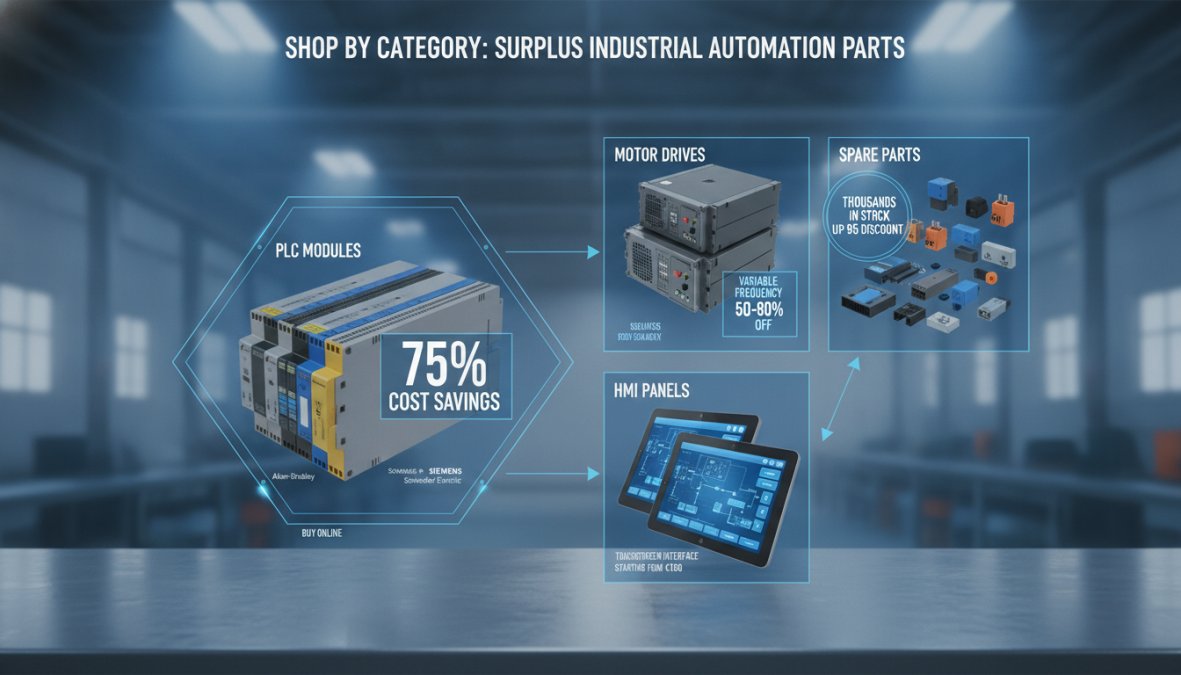
- PLC and DCS modules: Siemens S7, Allen-Bradley ControlLogix and MicroLogix, and legacy Modicon platforms are widely available. Check the firmware version before you buy.
- Drives and HMI panels: drives are often replaced in upgrades before the end of their working life. For panels from older automation systems, surplus is often the only source of a unit that runs the existing project without re-engineering.
- Circuit boards: the category most targeted by counterfeiters, so supplier verification is essential.
- Pneumatics and hydraulics: lower risk if seals and cycle counts have been inspected.
How to Buy Surplus Automation Parts Online Safely
Most teams find a good price and then try to verify the supplier. Reverse the order: verify first, then compare prices.
Before placing a surplus order, check that:
- the supplier is listed in a verified marketplace or distributor network,
- it can document where the part came from,
- test reports are available for electronic components,
- the return policy and warranty are in writing,
- part markings, labels and serial numbers match the OEM's.
Then check compatibility. A physically identical module can still be the wrong part:
- the exact part number, including the revision suffix,
- firmware compatibility with your system software,
- regional certification marks (CE, UL, CSA),
- the communication protocol for networked devices.
Surplus parts sold as-is carry no warranty; refurbished parts usually come with a limited seller warranty. Look for a defined period, a clear statement of what is covered (dead on arrival or functional failure), the return process and who pays shipping on a claim.
Test before deployment. Bench-test PLC modules: power them up, connect a programmer or HMI and check every I/O channel. For drives, inspect for burnt components and capacitor condition, test insulation on the power terminals, power up at reduced load, test communication and finally run at rated current. Drives that have been stored for more than about two years should have their DC bus capacitors reformed before a full-load test. For safety PLCs, safety relays and other components in safety functions, use only certified refurbishment documented to IEC 61508 or ISO 13849.
From Part Number to Purchase Order on a Multi-Supplier Platform

Sourcing across a supplier network works differently from ordering from one distributor:
- Identify the part. Use the OEM part number from the nameplate or documentation. When it is missing, search by specification: voltage, current, protocol, form factor and manufacturer. Cross-references surface superseded part numbers and equivalents from other manufacturers.
- See the market. One search shows every supplier holding the part, with quantity, price breaks, lead time and location. In-stock from a supplier in your region is a different offer from a twelve-week factory lead time at a similar price.
- Send one RFQ. For non-standard or high-value parts, one structured request to several verified suppliers replaces five separate email threads and returns comparable quotes.
- Order and track. Order in-stock parts directly and follow status and shipping in one place instead of in each supplier's system.
- Connect it to your ERP once volume justifies it. Most integration problems sit in the data, not the connection: platforms use manufacturer part numbers, your ERP uses internal material numbers, and one physical part can carry several manufacturer numbers across generations and regional variants. Build and maintain a cross-reference table between them, and make sure order confirmations and shipping updates flow back to the ERP, not only the purchase order out.
How to Negotiate With Automation Parts Distributors
Most buyers negotiate only the unit price, and distributors expect it: a small discount often comes with the lead time, minimum order quantity and warranty left entirely on the distributor's terms. Negotiate the total cost of getting the part instead, which has four parts:
| Variable | Why it matters | What to ask for |
| Unit price | Competitive for standard catalog parts; supply is tight for obsolete ones, so price moves little | Price breaks for volume or a framework agreement |
| Lead time | When a line is down, a guaranteed delivery date is often worth more than a discount | A committed delivery date and a remedy if it is missed |
| Minimum order quantity | MRO buyers often need one or two units, and an MOQ forces stock you will never use | A waiver of the MOQ on that line, especially on an established account |
| Warranty and returns | Defects in surplus or discontinued parts often show only in operation | A return window counted from installation rather than from receipt |
Three habits make these conversations work:
- Know the market first. Check the price and lead time from at least three sources before you ask. A distributor quoting an obsolete module far above the market is counting on you having no alternative; a multi-supplier search shows whether that is true.
- Consolidate, but keep a backup. Directing most of a category's spend to one or two distributors earns better prices and priority fulfillment. Keep a second verified source qualified for every critical part, so consolidation does not become single-source risk.
- Use account pricing. Most distributors and platforms price in tiers by annual spend and order frequency, and some show your negotiated prices at login. Concentrating spend with two or three verified suppliers usually earns more than chasing the lowest quote on every order, and the negotiated price then applies to every requisitioner and every plant.
- Put it in writing. Payment terms (for example net 30 or net 60), delivery dates, MOQ waivers and warranty terms belong on the purchase order or order confirmation. A verbal promise from a sales representative does not bind the distributor's operations team. For purchases in a foreign currency, agree who carries the exchange-rate risk.
Why Prices for the Same Part Move
Prices for automation parts are less stable than a single quote suggests. A few signals move them, and knowing them helps you decide when to buy:
- Stock across the network: when several distributors run low on the same part number at once, prices rise, often before the manufacturer announces a longer lead time.
- Manufacturer lead times: a longer factory lead time pushes distributor and surplus prices up quickly, especially for semiconductor-heavy drives and controllers.
- Buying peaks: demand clusters around planned shutdowns, capital projects and year-end budgets. Parts for planned maintenance are often cheaper bought outside those windows.
- Region: the same part number can be priced differently in different regions because of local stock, duties and demand.
Emergency purchases are where price movements hurt most. For parts that are both critical and volatile in price, a larger safety stock usually costs less than buying at peak emergency prices.
Cross-Border Purchases: Landed Cost, Customs and Export Controls
The unit price on a foreign quote is not the landed cost. Before you buy across borders, check:
- HS classification: automation parts usually fall under chapter 85 (electrical equipment such as PLCs, sensors and drives), 84 (pneumatic and hydraulic actuators) or 90 (some measuring instruments). A wrong code means customs delays and duty errors.
- Duties and trade agreements: preferential rates apply only when the supplier provides valid proof of origin.
- Export controls: some high-performance PLCs, motion controllers and precision sensors are dual-use items and may need an end-use statement or an export licence.
Keep the Right Spares on Hand
The cheapest emergency purchase is the one you never have to make. Classify spares by criticality and stock accordingly:
- Critical (A): failure stops production; keep in stock locally.
- Important (B): failure degrades performance; stock based on lead time against acceptable downtime.
- Standard (C): short lead times and wide availability; order on demand.
For every critical part with only one qualified supplier, pre-qualify an alternative supplier or an equivalent part during a planned maintenance window, not during an outage. Spread critical sources across at least two regions. Our guide to identifying critical spare parts shows how to build the list, and the cost of unplanned downtime explains what it saves.
If you have the opposite problem, shelves of parts you no longer need, see how to sell surplus inventory and industrial asset recovery. Photograph and catalog part numbers and condition before a line is dismantled; it raises resale value.
Frequently Asked Questions
Where can businesses source industrial automation components?
From OEMs and their authorized distributors for current parts, independent distributors and surplus sellers for discontinued parts, and online parts search platforms that show the stock of many suppliers at once. Searching the exact part number on a multi-supplier platform such as Automa.Net is usually the fastest way to compare availability, price and lead time.
What is the best website to buy automation parts?
It depends on the part. For industrial automation parts across many brands, a marketplace that aggregates real-time stock from verified suppliers, such as Automa.Net, lets you compare offers and send one RFQ. For electronic components against a BOM, engineering-focused search engines such as Octopart or NetComponents are common choices.
How do I choose an automation parts supplier?
Check quality certification (ISO 9001 plus any sector standard), the ability to provide a certificate of conformance, RoHS and origin documents, documented counterfeit controls and traceability, and financial stability. Test a new supplier on a part whose price and lead time you already know.
What is an industrial spare parts supplier network?
A group of verified distributors, OEM representatives, surplus traders and repair shops that you can search and order from through one channel. Compared with a single distributor, it gives you more stock to choose from, price benchmarks across suppliers and alternatives when one source runs out, which matters most for obsolete parts.
How do I negotiate better terms with a parts distributor?
Negotiate total cost, not only unit price: lead time with a committed delivery date, minimum order quantity, warranty and return terms, and payment terms. Know the market price from several sources before you ask, and record everything you agree on the purchase order.
Which wholesalers specialize in industrial automation and MRO components?
Independent automation distributors and surplus traders specialize in PLCs, drives, HMIs and other MRO components across many brands, while authorized distributors cover the current range of the manufacturers they represent. A multi-supplier platform lets you search both kinds at once and compare their stock, price and lead time for the exact part number.
How do I find a modern equivalent for a discontinued drive or PLC?
Start with the manufacturer's migration path from the discontinued series to its successor, then search the part number on a platform with cross-references to find superseded and equivalent parts. Check the rating, communication protocol, footprint and whether the program or parameters have to be converted before you order.
Is it safe to buy surplus automation parts online?
Yes, when you buy from verified suppliers that document where the part came from, provide test reports and give a written warranty and return policy. Check the part number revision and firmware before buying, and bench-test the part before installing it.
Can I source all automation parts from a single supplier?

Rarely. No distributor stocks every manufacturer and product generation, and relying on one source is a risk for critical parts. A multi-supplier platform gives you one place to search and order while keeping several suppliers behind each part.
Other Posts

Navigating the Automation Trade: A 10 Points Guide to Multi-Channel Parts Sales and Enhanced Visibility
Discover expert tactics for automation parts suppliers to diversify sales channels, leverage e-commerce, partner with distributors, and more opportuni...
Read More →
Independent Distributors vs Authorized Distributors in Industrial Automation: When to Use Each
What independent distributors and brokers do in industrial automation, how they differ from authorized distributors, the risks and how to vet them.
Read More →
Scalability Without Headcount: Transforming Your BaseLinker Inventory into a Global B2B Sales Engine
Learn how to integrate BaseLinker with Automa.net to reach 700+ global partners , boost revenue by 26% , and save 100 hours of manual work monthly.
Read More →