Sourcing Legacy Automation Components in Europe: 2026 Guide

Why Legacy Automation Parts Are Getting Harder to Source
A Siemens SIMATIC S5 output card fails on a packaging line. The OEM discontinued the module years ago, and the quoted lead time on any successor is measured in months.
The pressure is structural. European factory automation and industrial controls represented a market the Mordor Intelligence Europe factory automation and industrial controls analysis puts at USD 74.07 billion in 2026, with projected growth of 8.12% annually.
Buyers are hunting discontinued parts, end-of-life components and hard-to-find industrial parts across fragmented distributor stock.
How to Identify Obsolete PLC Spare Parts Before You Order
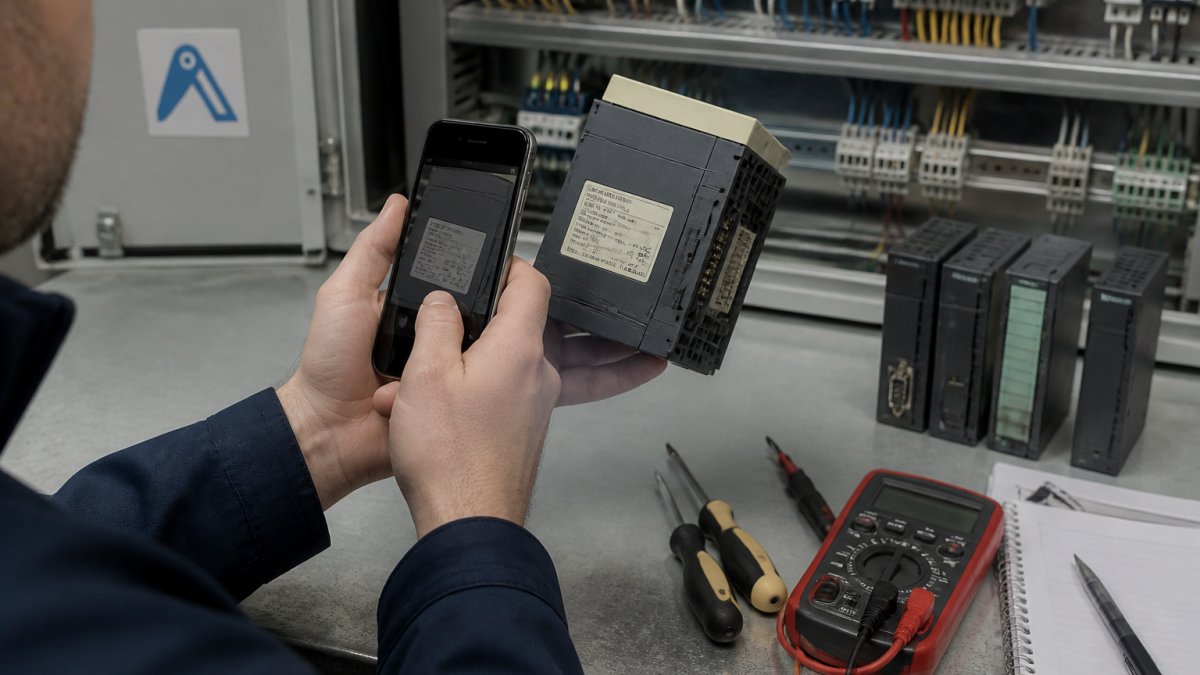
Identification is the first failure point. A wrong order costs you a return, a week of freight and another week of downtime.
Start with the nameplate, not the manual. The manual describes the family; the nameplate describes the exact unit in your cabinet. Record the manufacturer, the full order number, the serial number and the hardware revision. Siemens, Allen-Bradley, ABB, Schneider, Fanuc and Beckhoff all use different numbering conventions, and a single suffix can separate a 24 V DC input card from a 230 V AC variant that will not fit your rack.
The part number and nameplate workflow
- Photograph the nameplate in good light, including any sticker added by a previous retrofitter.
- Cross-check the order number against the module's physical label, not the BOM, which is often stale.
- Note firmware or hardware revision, since compatible replacements may require a matching level.
- Pull the machine's electrical drawing to confirm the slot and wiring.
- Search the exact model number, then widen to the family if nothing appears.
AutomaSnap exists for step one: you photograph the nameplate and it can be matched against the network's inventory data, which removes most transcription errors before they reach a quote request.
OEM, Refurbished PLC Systems or Surplus Stock: What Actually Fits
There is no universal best option. The right choice depends on how long the machine must run, how critical the line is, and whether a migration is already funded.
| Option | Typical strength | Main risk | Best for |
| OEM new stock | Warranty, documentation | Long lead time, high price, may be discontinued | Critical lines with a funded budget |
| Refurbished PLC systems | Faster availability, lower cost | Condition varies by supplier | Mid-term gaps where testing evidence exists |
| Surplus / New Old Stock | Often the only source for end-of-life parts | Unknown storage history | Legacy lines with no migration date |
| Repair of existing module | Keeps original configuration | Turnaround time, repeat failures | Single failed units, otherwise healthy systems |
New Old Stock means original, unused parts that sat in someone's warehouse, sometimes for a decade. Reconditioned parts have been repaired and tested. Both can be sound, but only if the supplier documents condition and test scope.
Where Surplus Automation Components Come From
Surplus stock is not a random pile. It accumulates predictably: machine builders holding commissioning spares, plants that decommissioned a line, distributors with slow-moving inventory, and maintenance departments that over-ordered during a previous shortage.
That origin matters for you. A part from a decommissioned line usually has real service history and may be a tested pull. A part from a distributor's shelf is closer to New Old Stock.
Selling your own surplus is the mirror image of buying. If your warehouse holds obsolete components you will never fit again, listing them through Surplus Solutions turns dead stock into working capital and puts hard-to-find parts back into circulation for a buyer who needs exactly that module.
Vetting Suppliers for Hard-to-Find Industrial Parts
Supplier quality separates a working replacement from a second failure. A cheap module with no test record is not a bargain. The problem is that most buyers vet on price and lead time, then discover the condition gap after the part is in the cabinet.
Build the vetting around evidence, not assurances. Ask for the same six artefacts from every supplier, including us, and score them side by side before you commit.
| Evidence requested | What good looks like | Red flag |
| Exact part and revision | Full order number plus hardware/firmware revision, matching the nameplate | Family name only, or "compatible with" |
| Condition category | Explicitly new, New Old Stock, reconditioned or used pull | "Tested" with no category |
| Test scope | Named tests: power-on, I/O loop, communication, load test where relevant | "Fully tested" with no detail |
| Provenance | Decommissioned line, distributor shelf, OEM surplus, stated plainly | Refusal to say where stock came from |
| Visual evidence | Photos of the actual unit, including connectors and any repair marks | Stock photo only |
| Commercial terms | Warranty period and return window in writing | Verbal warranty, no return path |
Counterfeit and mislabelled risk
Legacy parts attract relabelling. A module sold as an OEM original may be a repaired unit with a new sticker, or a different revision dressed as the one you ordered. You do not need a lab to reduce that risk. Check the label against the physical moulding, confirm the revision matches the drawing, and ask the supplier to explain any discrepancy before shipping.
Comparing suppliers on capability, not just stock
Two suppliers can both list the same Siemens S5 card and be nothing alike. Compare them on four axes: product coverage (do they actually hold legacy families, or list them on request), test capability (in-house or outsourced), warranty terms, and response competence on technical questions.
Apply the same test to any marketplace you use: the network is verified, but you should still confirm condition and test evidence for the specific unit before it ships.
Find it on Automa.Net →
Cross-Border Sourcing: Customs, Documentation and Logistics
Buying from another EU member state is straightforward on paper and slow in practice if the paperwork is wrong. The commercial invoice must carry a precise goods description, the correct commodity code, the part number, the country of origin and the stated value. Vague descriptions like "electronic spare parts" invite customs queries and hold the shipment.
What the invoice and paperwork must carry
- A goods description specific enough to classify the part, not a family name
- The commodity (HS) code the supplier and you agree on
- The exact part and order number, matching the nameplate
- Country of origin, which is not the same as country of dispatch
Keep the tracking, the supplier's test report and the invoice in one file. If a module arrives damaged, that file is your claim, and reconstructing it after the fact is slow.
VAT and intra-EU movement
For business-to-business supplies between EU member states, the reverse-charge mechanism normally applies: the supplier invoices without VAT and you account for it under your own VAT registration, provided both parties' VAT numbers are valid and stated. Get the VAT number wrong and the invoice is defective, which delays both the shipment and your input-tax recovery. For goods moving to or from outside the EU, import VAT and duty apply at the border and the commodity code drives the rate, which is why the code on the invoice matters more than the description.
Repaired and returned goods
Sending a failed module out for repair and getting it back is not a normal sale. Document it as a repair movement, keep the original export and the return reference together, and confirm with the repairer how the return is declared. Mishandled repair movements are a common cause of double duty and stuck shipments.
Freight choice by part type
A courier parcel is fine for a sensor or a small card. For a servo drive or a full PLC rack, use a freight forwarder with shock and humidity protection, and insure at replacement value, not invoice value. Turnaround time on a hard-to-find part is often dominated by logistics, not by finding the stock, so plan the freight before you confirm the order.
Repair, Replace or Migrate: Deciding the Next Step
The honest question is not "can we find the part" but "how long do we intend to keep this machine". Answer that first, and the sourcing decision follows.
If the machine has years of service left and the failure is a single module, repair or a tested replacement is the pragmatic move. If failures are becoming frequent across the same system, you are funding a slow migration through spare-part spend.
A practical middle path: keep the legacy line running with verified spare stock while you build a migration plan, and use the interim to standardise your BOM data. Cleaning and repricing your bill of materials with BOM List Cleaner shows you which components are genuinely obsolete and which have current equivalents, so the migration is scoped on facts rather than assumptions.
Frequently Asked Questions
Where can you buy obsolete industrial automation parts?
The realistic options are the OEM's legacy stock or repair service, specialist parts marketplaces, and brokers holding surplus stock. OEM lead times for discontinued items can run long, so most buyers run a parallel search. Marketplaces that aggregate inventory across many distributors show availability and stock condition in one place, which shortens the search. Always ask for the actual stock condition, not just the part number, because legacy automation stock varies widely between sellers.
How do you verify a legacy PLC part number before ordering?
Read the nameplate on the module itself, not the drawing or the BOM alone. Record the full order number, the hardware revision and the firmware version, because the same model can exist in several variants that are not interchangeable. Cross-check the number against the manufacturer's legacy documentation where it is still online. If the nameplate is unreadable, photograph it and use a nameplate identification tool to read the number before you send an RFQ.
What should you check when buying refurbished automation components?
Ask what was tested and how. A useful answer names the functional test performed, the test bench or load used, and whether firmware was reset or updated. Request photos of the actual unit, including the nameplate and any signs of repair. Confirm the warranty terms and the return path in writing. For refurbished PLC systems, ask whether the backplane and power supply were tested together, since a working CPU in a failing rack still causes downtime.
Is surplus automation stock the same as refurbished stock?
No. Surplus means unused stock that was bought and never installed, often New Old Stock from a plant closure or an over-ordered project. Refurbished means the unit was used, then cleaned, tested and repaired where needed. Surplus automation components usually carry the original packaging and no wear, but they may have sat in storage for years, so check storage conditions. Refurbished parts carry more test evidence but more history. Price and risk differ, so match the option to the criticality of the machine.
What information should an RFQ include for a hard-to-find component?
Include the exact order number, the model number and the revision, plus a photo of the nameplate. State the quantity, the required condition (new, New Old Stock, refurbished or as-is), and the date the machine needs to be running. Add the application context, such as the drive or rack the part sits in, because it helps a supplier confirm compatibility. A complete RFQ gets accurate quotes instead of a round of clarifying emails that costs you days.
How do you reduce the risk of buying counterfeit or misrepresented automation parts?
Buy from suppliers who can show traceability: where the unit came from, what was tested, and what the warranty covers. Ask for photos of the actual unit rather than a stock image, and compare label print quality and nameplate data against the manufacturer's format. For hard-to-find industrial parts, insist on written condition terms in the quote. A supplier who cannot describe the test process or the source is a risk you do not need on a critical machine.
Your next obsolete part will not wait for a quarterly review. When a module fails, the fastest route from a nameplate photo to verified stock is to search the network on AutomaSEARCH or broadcast your requirement through the Request Board, and let suppliers with real inventory respond. That is the specific next step we would take today.
Find it on Automa.Net →
Other Posts

7 Tactics for Negotiating Bulk Pricing on Industrial Components
Master negotiating bulk pricing industrial components with supplier comparison tactics. Learn how to secure volume discounts and lock in better terms.
Read More →
Critical Spares Matrix: A Practical Guide for MRO Teams
Build a critical spares matrix ranking parts by risk, lead time and production impact. Includes a template and steps for obsolete automation parts.
Read More →
Finding Hard-to-Find PLC Parts: A 2026 Sourcing Guide
Learn a repeatable process for finding hard-to-find PLC parts: part number lookup, compatibility checks, and sourcing obsolete or refurbished modules.
Read More →