Why Legacy Industrial Equipment Needs Better Stock Visibility

Why Aging Machinery Exposes the Gaps in Stock Visibility
A line stops because a 20-year-old drive fails, and nobody can say whether a replacement sits on a shelf two buildings away or nowhere in Europe. That is the stock visibility problem in one sentence: the machine is known, the part is not. Legacy assets can hide their dependencies in paper BOMs, tribal knowledge and dead part numbers.
Stock visibility is the ability to know, at any moment, which spare parts exist in your estate, where they are, and whether they fit a specific machine. For legacy equipment, that knowledge usually breaks down long before the machine does.
The operational problem behind missing spare parts
The failure mode is rarely dramatic. A sensor fails, maintenance checks the stores system, and the part number returns nothing. The number was superseded twice since 2008.
Three gaps cause most of it:
- Part numbers that no longer exist in any current catalog
- BOMs that were never digitized, or were edited by hand over decades
- Stock records that describe what was bought, not what is still usable
Each gap turns a routine swap into a sourcing project.
Why legacy systems resist connection
Older equipment often speaks proprietary or obsolete protocols, which makes integration work rather than a simple monitoring add-on.
Replacement is not automatically the answer either.
A systematic review of legacy manufacturing in Industry 4.0 contexts catalogs the retrofit technologies, hardware and protocols available for exactly this situation (Alqoud et al., Manufacturing Review, 2022).
For a deeper walkthrough of managing inventory around legacy assets, see our guide to managing industrial inventory for legacy machines.
Connecting Legacy Equipment to Modern Data Streams
The practical route is a retrofit layer, not a rip-and-replace. You add gateways or protocol converters that translate older fieldbus traffic into something your systems can read. Then machine data and inventory data meet in the same place.
Start narrow. Pick the assets whose failure hurts most, connect those first, and feed consumption signals into your stock records. Broad rollouts stall; targeted ones ship.
Retrofit versus replacement: what the research says
The evidence favors retrofit where the machine itself is sound. The MDPI case study describes a building-management integration at an automotive manufacturing facility, focused on interoperability with legacy systems and local protocols. It reports no measurable outcome, so treat it as a method reference rather than a results claim.
Building a Critical Spare Parts List for Obsolete Machines
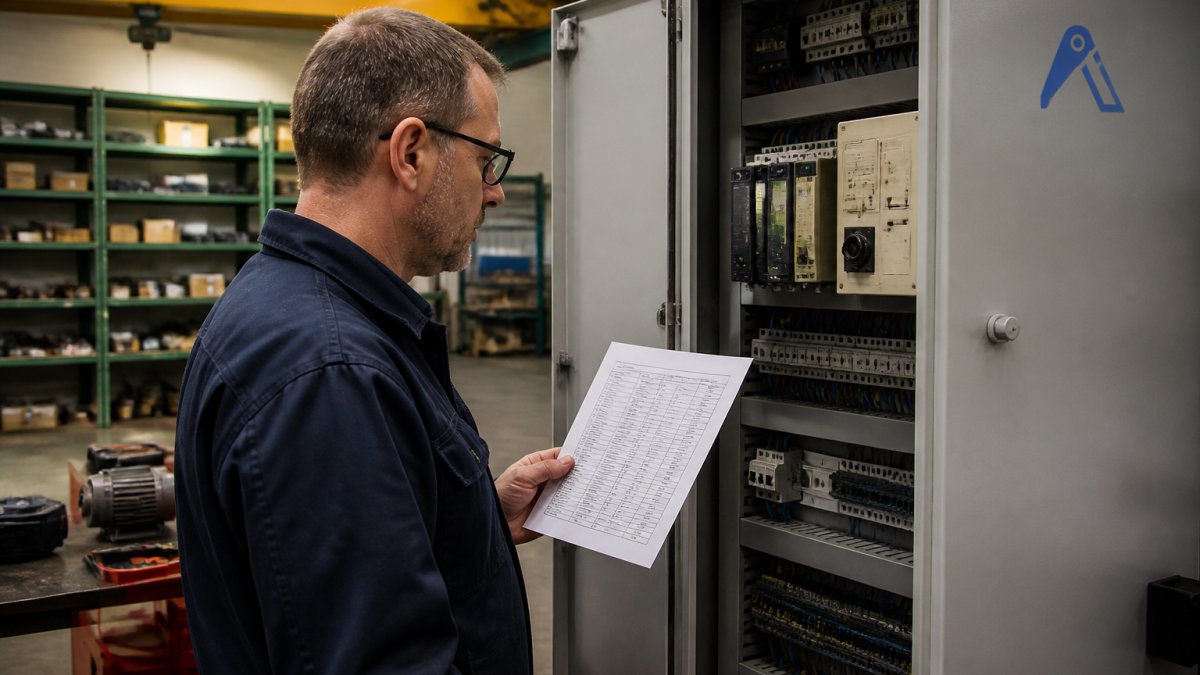
A critical spare parts list ranks every part by the damage its absence causes: line stop, quality risk, safety issue, or inconvenience. Obsolete machines need this list more than new ones, because sourcing lead time replaces OEM availability as your constraint.
Build it in four passes:
- List every asset and its failure history
- Extract part numbers from drawings, nameplates and old invoices
- Score each part on downtime impact and sourcing difficulty
- Set a holding rule per tier: on-site, network-sourced, or build-to-order
Discontinued PLC Replacement: Sourcing When the OEM Line Ends
When a PLC family reaches end of life, the OEM stops producing it long before your machines stop needing it. Sourcing then splits into three routes: remaining OEM stock, verified refurbished units, and surplus from other plants. Each has a different risk profile, and none should be bought blind.
Check what is actually listed before you redesign anything. Our Siemens spare parts page shows current stock and alternatives.
Industrial Spare Parts Inventory Management: The Data Architecture
Industrial spare parts inventory management for legacy estates rests on one principle: every part record must carry a machine link. A part number without an asset reference is a warehouse item, not a spare.
The four records and what each must hold
- Asset register as the anchor: model, serial, commissioning year, control platform (PLC family, fieldbus), and the name of the person who last signed off its BOM
- BOM per asset, versioned rather than overwritten, so a 2011 revision and a 2019 revision can both be read when a machine is rebuilt
- Part master with cross-references to superseded and equivalent numbers, including the OEM's own supersession chain where it is documented
Skip the cross-reference layer and your team will keep searching by memory.
How the data actually meets
Machine data and inventory data rarely meet on their own. The practical pattern is a three-hop path:
Find it on Automa.Net →
- Machine to gateway. A retrofit gateway or protocol converter reads the legacy fieldbus, PROFIBUS DP, Modbus RTU, older vendor-specific serial, and republishes it over OPC UA or MQTT. This is the hop that most projects underestimate, because the protocol map for an obsolete controller is often undocumented.
- Gateway to a consumption event. Raw signals are not stock movements. You need a rule that turns a signal into an event: a tool-change counter, a cycle count, a vision-system reject, a weigh-scale reading. Without that rule you have telemetry, not inventory.
- Event to the stock ledger. The consumption event decrements the ledger against the asset's BOM line, not against a free-floating part number. This is what makes the machine link real rather than decorative.
Barcode and RFID scans sit alongside this path, not inside it. A scan at the stores counter confirms physical movement; the machine event confirms consumption. Reconciling the two is where stock accuracy is won or lost.
Handling duplicate and superseded records
Legacy estates accumulate duplicates faster than new ones, because every reorganisation, every stores relocation and every ERP migration leaves a residue. Three rules keep the part master clean:
- One canonical number per physical part. Superseded numbers become aliases, never separate records.
- A merge log. When two records are merged, the losing number is retained as a pointer, so old invoices and drawings still resolve.
- A quarantine flag. Records that cannot be verified against a nameplate or drawing are flagged, not deleted, so a buyer knows the difference between "we have it" and "we think we have it".
Where incompatible protocols bite
Older equipment often speaks proprietary or obsolete protocols, which makes integration work rather than a simple monitoring add-on. Research on connecting legacy industrial equipment to modern IoT systems identifies protocol barriers as one of the core reasons these machines resist connection (Wirtek analysis of legacy equipment connectivity).
A systematic review of legacy manufacturing in Industry 4.0 contexts catalogs the retrofit technologies, hardware and protocols available for exactly this situation (Alqoud et al., Manufacturing Review, 2022).
For a deeper walkthrough of managing inventory around legacy assets, see our guide to managing industrial inventory for legacy machines.
BOM Management for Maintenance: The Backbone of Stock Visibility
BOM management for maintenance is where most visibility projects succeed or fail. A maintenance BOM differs from an engineering BOM: it lists what you actually replace, not everything designed in.
Messy BOM data blocks every downstream step. Duplicate lines, missing alternates and dead numbers all produce false stockouts. Cleaning the list is unglamorous work with the highest payoff.
Our BOM List Cleaner helps clean BOM data.
OEM, Refurbished or Surplus: A Checklist for Verified Stock
| Route | Strength | Main risk | Best for |
| OEM new | Full traceability | Long lead time, high price | Safety-critical, warranty-bound parts |
| Refurbished | Faster availability | Variable test documentation | Drives, HMIs, power supplies |
| Surplus | Often the only stock left | Unknown storage history | Discontinued PLCs, legacy I/O |
Before you buy any of the three, confirm:
- [ ] Exact part number and revision match the machine
- [ ] Test or inspection documentation available
- [ ] Seller can confirm condition and storage
Measuring Stock Visibility: KPIs and the Business Case
Visibility is measurable, which means it can be defended in a budget conversation. The mistake is to track everything. Four numbers carry the argument, and each needs a defined method, not just a name.
The four KPIs and how to measure them
| KPI | What it answers | How to measure it |
| Fill rate from own stock | How often a critical part is on the shelf when the machine stops | Count critical-part requests fulfilled from free stock, divided by total critical-part requests, over a rolling quarter |
| Sourcing lead time | How long a request takes from raise to delivery | Timestamp the request at raise and at goods-in; report the median, not the average, because a few long tail events distort the mean |
| Stock accuracy | Whether the ledger matches the shelf | Cycle-count a sample of critical parts each month against the ledger; report the percentage of lines that match exactly |
| Downtime hours attributable to parts unavailability | What the gaps actually cost in lost production | Tag every stoppage with a cause code; isolate the code for "part not available" and sum the hours |
Two of these are leading indicators and two are lagging. Fill rate and stock accuracy tell you whether the architecture is working before a line stops. Sourcing lead time and downtime hours tell you what it cost when it did not.
Setting a baseline before you change anything
You cannot defend a business case without a before number. Run the four KPIs for one quarter on the current paper-and-memory process, even if the data is rough. A rough baseline beats no baseline, because the budget conversation is about direction, not precision.
Building the business case
The case rests on three levers, and none of them require a forecast:
- Downtime avoided. Every hour of parts-attributable stoppage removed is production recovered. Use your own downtime hours and your own line output, not an industry average.
- Working capital released. Better visibility lets you hold less buffer stock of the parts you can source quickly, and more of the parts you cannot. The total holding may not fall, but it moves to where it protects the line.
- Buyer time recovered. The hours your team spends hunting part numbers by memory and email are real labour. Count them for one month and multiply by the loaded rate.
Manufacturing guidance for 2026 frames real-time insight into inventory, costs and supplier performance as a precondition for earlier decisions (Eide Bailly, What Manufacturing Executives Should Prioritize in 2026). That is the business case in one line: faster decisions, fewer line stops.
Work on inventory management and its effect on supply in manufacturing links stock practice directly to purchasing and inventory cost (Silva et al., Journal of Logistics, 2025).
When the baseline shows a critical part is genuinely unobtainable, the next step is to raise a request against the network rather than redesign the machine. Our Request Board lets you broadcast RFQs.
Frequently Asked Questions
Why is spare-parts visibility important for legacy industrial equipment?
Legacy machines can require obsolete or hard-to-find components. Stock visibility tells you what you hold, where it sits, and whether it fits the installed revision. Without it, buyers may chase parts already in a warehouse rack or order duplicates.
How do you manage spare parts for obsolete machinery?
Start with a critical spare parts list built from the BOM and the failure history of each asset. Record the exact part number, the installed revision, and acceptable substitutes. Then check availability across a wider supplier network rather than a single OEM channel.
How can you find discontinued PLCs and drives?
Search by exact part number and nameplate data, not by product family. Photograph the nameplate, confirm the revision and any firmware variant, then query a network of distributors and brokers rather than a single catalogue. Automa.Net's AutomaSEARCH helps you find parts across its supplier network. Always confirm the seller's stock status and condition before committing an order.
What is the difference between OEM, refurbished and surplus automation parts?
OEM parts are from the original manufacturer. Refurbished and surplus parts are other sourcing routes. Check the condition, available documentation and return terms for each, and match the choice to how critical the asset is to production.
The next step is small: pick your ten most critical legacy parts and check whether each one can be found and verified today. That is exactly what AutomaSEARCH is built for, searching real in-stock inventory across 700+ suppliers and 14.8 million+ listed products. Get started with Automa.Net and turn a blind spot into a verified stock position.
Find it on Automa.Net →
Other Posts

Sourcing Legacy Automation Components in Europe: 2026 Guide
Sourcing legacy automation components in Europe means identifying parts, vetting suppliers and managing cross-border risk.
Read More →
7 Tactics for Negotiating Bulk Pricing on Industrial Components
Master negotiating bulk pricing industrial components with supplier comparison tactics. Learn how to secure volume discounts and lock in better terms.
Read More →
Critical Spares Matrix: A Practical Guide for MRO Teams
Build a critical spares matrix ranking parts by risk, lead time and production impact. Includes a template and steps for obsolete automation parts.
Read More →