FANUC Servo Motor Repair vs Replacement Cost Analysis

Servo motor repair usually costs less than replacement when the damage is minor, but the cheapest quote is not always the lowest total cost. Add lead time and downtime to every option, because a stopped robot axis often costs more than the motor itself.
- Repair cost includes diagnosis, parts, labour, testing and freight both ways, so ask for an itemised quote.
- A new OEM motor carries the highest capital outlay and the longest lead time, often weeks.
- Refurbished exchange sits between new and repair, but only helps if your exact part number is in stock.
- Prove whether the motor or the drive failed before buying either, since replacing the wrong one doubles your cost.
- Total cost of ownership combines part or repair price, downtime hours and the risk-adjusted cost of repeat failure.
Repair vs Replacement: The Cost Comparison Table
A servo motor fails on a bottleneck robot axis and production stops. The decision that follows, repair or replace, is rarely about the purchase price alone; it is about how fast you can get the axis running again.
Repair cost is the total outlay to restore a failed servo motor to service, including diagnosis, parts, labour and freight. Replacement cost is the price of a new or refurbished unit plus the downtime to source and fit it.
| Option | Typical Cost Profile | Lead Time | Risk |
| New OEM motor | Highest capital outlay | Longest, often weeks | Lowest, full warranty |
| Refurbished exchange | Mid-range, quoted per unit | Days to a few weeks | Moderate, depends on warranty |
| Repair of existing motor | Lowest if damage is minor | Short if parts are stocked | Repeat failure if repair is rushed |
| Surplus identical unit | Varies with availability | Fastest if in stock | Unknown service history |
The table shows the trade-off clearly: the cheapest line is not always the fastest, and the fastest is not always the safest. FANUC World's repair and exchange overview presents refurbished exchanges as a lower-cost route than new parts, but the right choice depends on how severe the failure is.
What Drives FANUC Servo Motor Repair Cost
FANUC servo motor repair cost is not a single number; it is the sum of several itemized lines, including diagnosis, parts, labour, testing and freight both ways. A bearing noise is a different job from a burnt winding, and the quote should reflect that. On a robot axis, the duty cycle and the mechanical load the motor sees make certain failure modes more likely than on a CNC spindle, which changes what the workshop has to inspect.
Failure severity and scope of work
The scope of work scales directly with what failed. A motor with worn bearings needs bearing replacement, cleaning and re-greasing. A motor with a damaged encoder, a shorted winding or a scored shaft needs component replacement and a full overhaul. On robot axes, the most common patterns we see are encoder degradation from heat and vibration, bearing wear from continuous reversing duty, and winding insulation breakdown after years of high-duty cycling. Each added operation raises the quote, and the honest workshops itemise it rather than quoting a flat figure.
Ask for the quote broken into these lines:
| Cost line | What it covers | What to check |
| Diagnosis | Bench test, alarm history review, insulation and encoder checks | Whether diagnosis is credited against the repair |
| Parts | Bearings, encoder, winding, shaft, seals | Whether parts are OEM-equivalent or generic |
| Labour | Disassembly, cleaning, reassembly, alignment | Hourly rate and estimated hours |
| Testing | Run-in, current draw, encoder output, vibration | Test report supplied with the unit |
| Freight | Inbound and return shipping, packaging | Who pays each leg and insurance cover |
A quote that collapses these into one figure hides where the money goes. If you want to cut maintenance spend beyond this single decision, these strategies for reducing industrial maintenance and repair costs cover the wider levers.
Warranty, testing and the risk of repeat failure
Warranty and acceptance testing separate a proper repair from a cheap one. FANUC World's repair and exchange overview presents refurbished exchanges as a lower-cost route than new parts, but the warranty behind the repair is what determines your real risk. Ask what test the motor passed before it shipped: a run-in under load, a current-draw check, an encoder output verification, a vibration reading. Ask what the warranty covers and for how long, and whether it includes labour to refit. A repair without a documented test is a gamble on the next shift.
Watch out: a warranty that covers only the part and not the downtime to remove and refit it leaves you carrying the larger cost if the repair fails early.
When FANUC Servo Motor Lead Time Tips the Decision
FANUC servo motor lead time often decides the question before cost does. When a new motor is weeks away and the line is stopped, a repair or a stocked refurbished unit wins on economics even at a higher unit price, because downtime dwarfs the part cost.
Picture a robot axis down on a high-volume cell. The new motor quote looks reasonable until you add three weeks of lost output. A repair with a short turnaround, or a surplus identical unit already in stock, restores production in days. ACT's servo motor repair versus replacement comparison frames the decision around cost, timelines, availability and performance together, which is the only honest way to weigh it. Lead time is a cost line, not a footnote.
Refurbished FANUC Servo Motor: The Middle Path
A refurbished FANUC servo motor sits between a new unit and a repair in terms of cost and assurance. It suits buyers who need a known-good unit fast and want a warranty behind it.
FANUC World's refurbishment process overview describes cleaning, component replacement and testing as part of the refurbishment scope, and presents refurbished exchanges as a way to avoid new-part pricing. The catch is availability for your exact model. A refurbished unit only helps if someone has your part number in stock. When you are weighing whether to keep legacy equipment alive at all, these ways to extend legacy equipment lifespan put the decision in context.
FANUC Servo Motor Part Number Identification Before You Commit
FANUC servo motor part number identification is the step that prevents an expensive wrong order. The model code on the motor body or nameplate determines compatibility, and a single wrong character can mean a motor that will not fit or run.
Photograph the nameplate before you call anyone. Record the full model code, the serial number and any specification plate on the drive cabinet. If the label is worn or missing, AutomaSnap can identify the part from a photo of the nameplate, which can help avoid a wrong order.
Motor vs Drive Fault Isolation: Diagnose Before You Spend
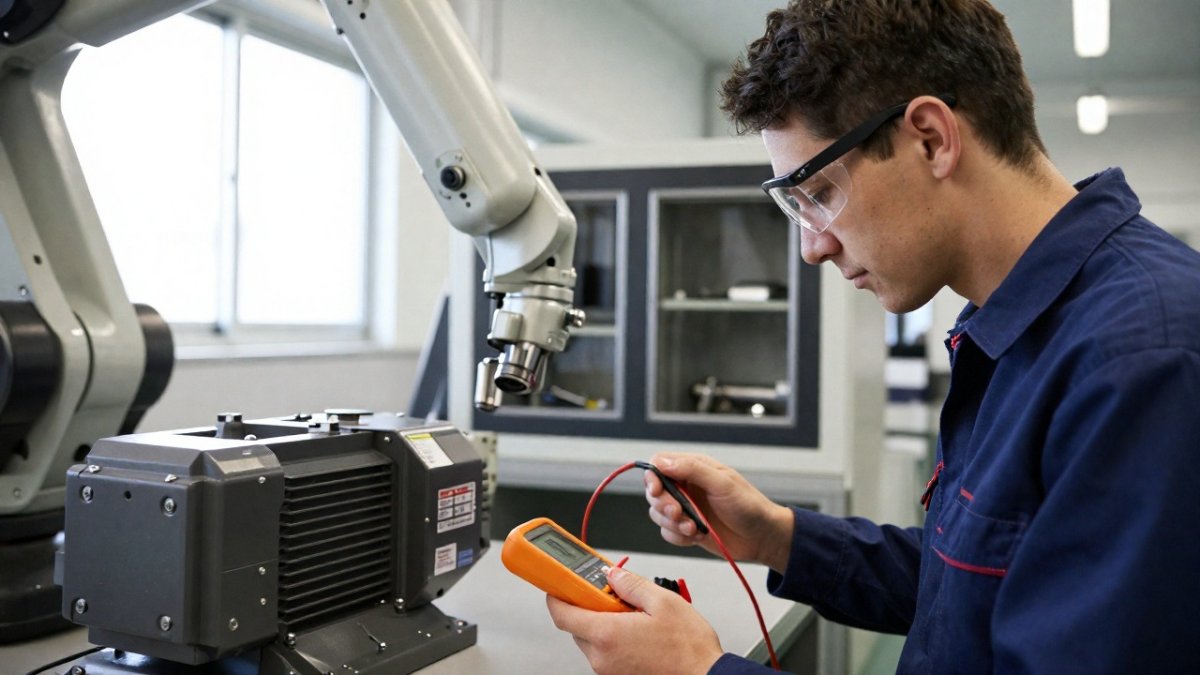
Motor versus drive fault isolation means proving which component actually failed before you buy either.
Work through these steps in order, cheapest first:
- Read the alarm history from the controller. Note the alarm code, the axis, and whether the fault is intermittent or persistent. An overcurrent or overload alarm on one axis only narrows the suspect list immediately.
- Inspect the power and encoder cables at both ends. Look for chafing at the robot wrist, loose connectors, bent pins and contamination. A cable fault on a robot axis is common because the harness flexes continuously.
- Check the shaft for play, scoring or resistance by hand with power off. Rough rotation points to bearings; free play points to mechanical damage.
- Swap the suspect motor onto a known-good drive, or swap a known-good motor onto the suspect drive. If the fault follows the motor, the motor is the problem; if it stays with the drive, you have saved the price of a motor.
- Measure winding resistance and insulation across phases. A shorted or open winding confirms a motor fault; balanced readings point back to the drive or cable.
- Verify the encoder signal if the controller supports it. Encoder faults often masquerade as motor faults because the drive cannot commutate correctly without a clean position signal.
This isolation step is where most rushed repairs go wrong. A motor replaced because of a chafed encoder cable fails again on the next shift, and the second failure costs more than the first because the real cause was never found.
Calculating Total Cost of Ownership and Downtime
Total cost of ownership for a servo motor combines purchase or repair price, expected service life, failure risk and the cost of every hour the axis is down. The unit price is the smallest part of the sum in most stopped-line scenarios.
Build the number in three lines: the part or repair cost, the estimated downtime hours multiplied by your cost per stopped hour, and the risk-adjusted cost of a repeat failure. A cheap repair with no warranty carries a hidden line for the second failure. For a deeper framework, see how to calculate total cost of ownership for industrial components, and to put a realistic figure on stopped output, read unplanned downtime in manufacturing and its hidden costs. The option with the lowest total, not the lowest quote, is the one to take.
Sourcing a Verified FANUC Servo Motor Through Automa.Net
Sourcing the part is where the decision meets reality. Once you know the part number and the scope of work, you need a supplier who actually has the unit in stock.
For MRO procurement teams, Automa.Net connects you to a verified network of distributors and machine builders listing in-stock inventory, so you can compare availability before committing. Procurement leads who want price intelligence on the replacement part can start with our sourcing tools for MRO procurement teams.
The next failed axis will not wait for a perfect analysis. Identify the part number, isolate whether the motor or the drive failed, and price the downtime alongside the part. Get started with Automa.Net to find a verified FANUC servo motor and cut the sourcing delay out of your repair-versus-replace decision.
Frequently Asked Questions
Is it cheaper to repair or replace a FANUC robot servo motor?
Repair is usually cheaper on paper. But the cheaper option is not always the lower total cost. If a rushed repair fails again in three months, you pay twice and lose production time twice. Compare repair cost plus warranty terms plus expected service life against the new motor price plus its lead time. Downtime often outweighs the part price difference.
How do you decide whether a FANUC servo motor is repairable?
Start with fault isolation. A servo amplifier alarm does not prove the motor is faulty. Check the drive, cables and encoder feedback before condemning the motor. Once the motor is confirmed as the fault, repairability depends on what failed. Bearing replacement, cleaning, encoder swap and winding repair are routine. A cracked shaft, damaged housing or burnt stator on an obsolete frame may push you toward replacement or a refurbished unit. Ask the repair shop for a written diagnosis before approving work.
What factors affect the cost of repairing a FANUC servo motor?
Failure severity is the biggest factor. A bearing and encoder job sits at the low end; a full rewind or shaft repair pushes cost up. Motor size and frame matter too, since larger motors need more labour and heavier tooling. Warranty length, acceptance testing and whether the shop returns a test report all affect the quote. Turnaround time is a cost factor as well, because every day the robot axis sits idle adds production loss to the repair invoice.
Can a refurbished FANUC servo motor replace an obsolete model?
Often yes, if you match the part number and specifications exactly. Refurbished units are rebuilt to OEM specifications with new bearings, cleaned windings and tested encoders. For discontinued models, refurbished or surplus stock can be the only realistic path when the OEM no longer supplies the old frame. Always verify the nameplate data and request a test report before accepting the unit.
What information do you need to source a compatible FANUC servo motor?
You need the full nameplate data: model number, serial number, rated voltage, current, speed and encoder type. A photo of the nameplate is the fastest way to capture this. AutomaSnap reads nameplates from a photo and matches them against the network, which removes most transcription errors. Add the robot model and axis if you have it. With those details, AutomaSEARCH can surface in-stock alternatives across verified suppliers instead of waiting on an OEM quote.
Other Posts

7 Ways to Buy Discontinued Siemens PLC Parts
Buying discontinued Siemens PLC parts? Compare 7 sourcing routes and verify condition before you commit.
Read More →
How to Fix Excess MRO Inventory Before It Ties Up Capital
Excess MRO inventory ties up working capital in parts you may never use. Learn how to separate safety stock from surplus and cut stock safely.
Read More →
PLC Module Repair: CPU and I/O Faults, Discontinued Series and Your Options
Common PLC CPU and I/O module faults, what to check before replacing a module, when repair beats surplus, and keeping old PLC families running.
Read More →