7 Ways to Buy Discontinued Siemens PLC Parts

To buy discontinued Siemens PLC parts, first confirm the exact lifecycle status of the part number, then check whether Siemens' OEM spare-parts service still supplies it. Where the OEM cannot, source from independent distributors, marketplaces or graded surplus stock, verifying identity, condition and test evidence before you order.
- First-generation SIMATIC S7-1200 modules enter phase-out on 1 November 2026, with new units purchasable until 31 October 2027.
- Siemens states selected original spare parts remain available for up to 10 years after discontinuation, and sometimes longer.
- Confirm the exact order number, including hardware revision and firmware, because successor guidance is keyed to it, not the product family.
- Check rack fit, I/O compatibility, communications and engineering project portability before migrating to a successor module.
- Treat every stock listing as unverified until you have a nameplate photo, written condition grade and named test protocol.
Why Discontinued Siemens PLC Parts Are Getting Harder to Source
A machine goes down on a Tuesday morning. The CPU is a S7-300 module, the line has run on it for fifteen years, and the replacement you need is no longer in active production.
Siemens has confirmed that first-generation SIMATIC S7-1200 modules enter phase-out on 1 November 2026, per Siemens Industry Online Support's advance discontinuation notice. New first-generation S7-1200 units remain purchasable until 31 October 2027, according to Eichler Service's lifecycle summary.
At Automa.Net, we see the consequence every week: buyers who assumed a part was still current discover it is phased out, then lose days working out which channel can actually supply it. Here is the broader sourcing playbook for obsolete components if you want the full picture before committing to one route.
Check the Siemens SIMATIC Lifecycle Status Before You Buy
The first step in buying discontinued Siemens PLC parts is confirming the exact lifecycle status of the part number, not the product family. Siemens publishes discontinuation notices and successor guidance through its support portal, and the difference between "active", "phase-out announced" and "discontinued" decides which sourcing channel is even open to you.
Three status markers matter most:
- Phase-out announced: the end date is published but new units are still orderable. Buy now if the unit is critical.
- Discontinued: no new production. Spare-parts service and independent stock are your options.
- Successor named: Siemens has published a replacement, which changes the buy-versus-migrate calculation.
If lifecycle phases are unfamiliar territory, our guide to industrial spare parts obsolescence management explains how the stages fit together and how to plan around them.
OEM Spare-Parts Service: What Siemens Still Supplies After Phase-Out
A discontinued product does not automatically mean manufacturer support has ended. Siemens states that selected original spare parts remain available for up to 10 years after discontinuation, and sometimes longer, per Siemens' spare parts supply policy. Some discontinued products are also handled on request.
The catch is that availability is product-specific. Siemens does not promise universal coverage, so the only reliable answer comes from checking your exact order number against the spare-parts service.
Where it cannot, the OEM channel closes and you move to independent stock.
Independent Distributors and Parts Marketplaces for Obsolete Stock
Independent distribution is one of the channels where obsolete Siemens stock can be found.
Treat every listing as unverified until you have evidence on five points. This is the checklist we would run before releasing a purchase order on any obsolete module, whether it comes from a single distributor or a marketplace:
- [ ] Exact identity: order number confirmed against the nameplate, including hardware revision and firmware, not just the family name (an S7-300 CPU 315-2 DP is not interchangeable with every 315 variant).
- [ ] Photographic proof: a photo of the actual unit with the nameplate legible, not a stock image. If the label is worn, ask for a nameplate read before you commit.
- [ ] Condition grade in writing: the grade stated explicitly in the quote, not implied by the listing title.
- [ ] Test evidence: the test protocol named, was the unit powered in a rack, which I/O was exercised, what firmware was loaded.
- [ ] Commercial terms: warranty length, return window, and whether returns cover commissioning failures rather than just dead-on-arrival.
- [ ] Seller identity: company registration, trading history, and a reachable technical contact, not just a sales inbox.
- [ ] Delivery commitment: a confirmed date against your shutdown window, in writing.
A cheap listing that fails several of these points can lose its apparent saving the first time a module fails under load in a rack with existing I/O wiring.
Watch out: a marketplace listing that shows "in stock" and a photo of a similar unit is not evidence of the specific unit you will receive.
The table below summarises the four channels against the criteria that decide most purchases.
| Channel | Typical condition | Lead time | Best for | Main risk |
| OEM spare-parts service | New, original spec | Varies by part | Critical units still supported | Part may not be covered |
| Independent distributor | New or refurbished | Days to weeks | Obsolete stock with warranty | Uneven verification |
| Parts marketplace | Mixed, listed per item | Days | Comparing many sellers fast | Listing accuracy |
| Used or surplus | Used, graded | Often immediate | Non-critical or bridge repairs | Unknown service history |
If you want a concrete starting list, our article on where to find Siemens automation parts distributors and suppliers maps suppliers and integrators by country.
Used Siemens PLC Modules: Condition Grades and Testing Evidence
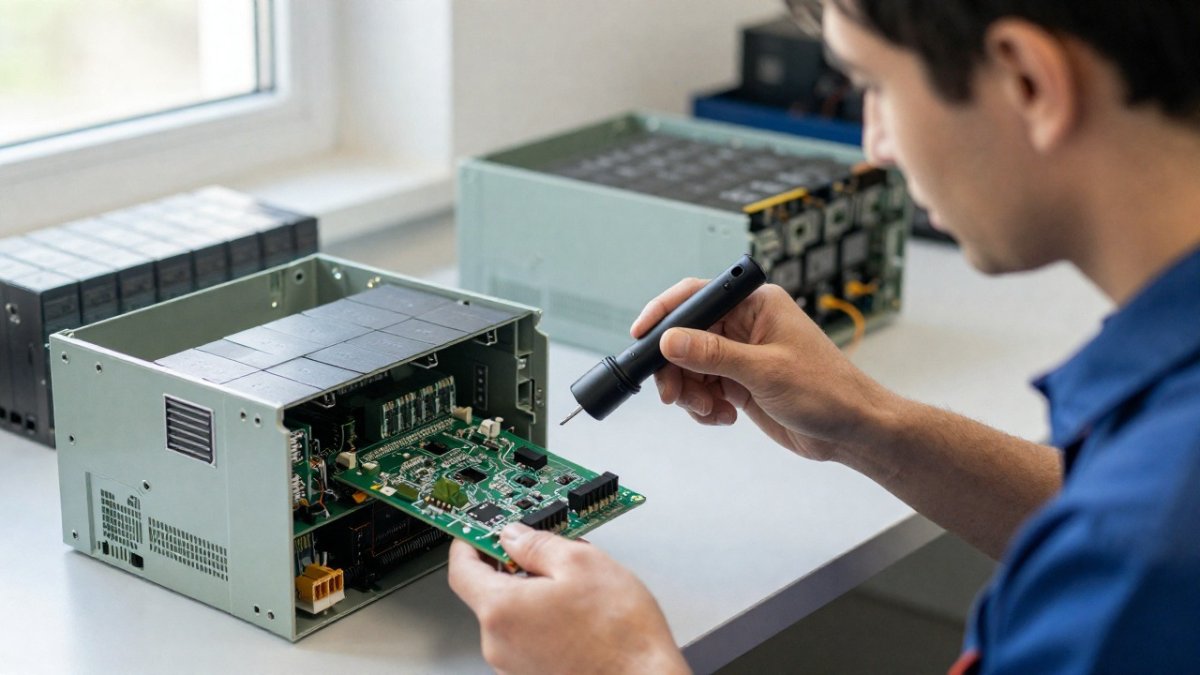
Used Siemens PLC modules are only worth buying when the condition grade and test evidence are stated explicitly. "Pulled from working machine" is not a grade.
Grade language varies between sellers, so translate it before you compare prices:
- New old stock: never installed, original packaging, but aged. Check for capacitor degradation on long-stored units.
- Refurbished: cleaned and tested, often with a warranty. Ask what the test covered.
- Used, tested: removed from service and functionally checked. Demand the test record.
- Used, untested: cheapest and riskiest. Only sensible for non-critical spares.
Watch out: a module that powers up on the bench can still fail under load in a rack with existing I/O wiring. Insist on a return window that covers commissioning, not just delivery.
Finding a Discontinued Siemens PLC Successor Before You Buy Another Unit
Before you buy another legacy unit, check whether Siemens has published a successor. Siemens support documentation can be used to look up a successor product for a discontinued item in SiePortal.
Compatibility is the deciding factor, and it is not a single yes-or-no. Work through it in this order before you commit either way:
- Exact part number and revision. Confirm the full order number of the module you are replacing, including hardware revision and firmware. Successor guidance is keyed to the exact order number, not the product family.
- Rack and mechanical fit. Check whether the successor occupies the same rack, uses the same terminal blocks and power supply, and fits the existing enclosure depth. A module that needs a new rack is a retrofit, not a swap.
- I/O and signal compatibility. Verify that the successor's I/O types, voltage ranges and channel counts match what your wiring and field devices expect. A change in signal type forces rewiring at the terminal level.
- Communications. Confirm the successor supports the bus or protocol your system uses, PROFIBUS versus PROFINET is the common fault line on legacy S7-300 and S7-400 installations. A successor that only speaks PROFINET will not drop into a PROFIBUS segment without a gateway.
- Engineering project portability. Check whether your existing project can be ported to the successor's engineering environment without a rewrite. A successor that needs a new engineering toolchain is a migration project, not a spare-part purchase.
- Firmware and function blocks. Confirm the firmware revision the successor ships with is supported by your engineering version, and that any function blocks your program depends on exist in the successor.
Answer all six before committing. A successor that passes steps 1 to 4 but fails step 5 is still a migration, and the cost calculation changes completely.
Watch out: a successor that is pin-compatible and fits the rack can still fail at the communications layer, which is the most common reason a swap that looked straightforward stalls at commissioning.
Where the successor passes the workflow, migrating is the durable route.
How to Verify Industrial Spare Parts Stock and Supplier Claims
Verifying stock claims is the step that separates a smooth purchase from a costly return. A listing that says "in stock" tells you nothing about whether the unit exists, matches the revision you need, or has been tested. Treat every claim as unverified until you have evidence.
Use this checklist before you release a purchase order:
- [ ] Exact order number confirmed, including firmware and hardware revision
- [ ] Photograph of the actual unit, with nameplate legible
- [ ] Condition grade stated in writing, not implied
- [ ] Test evidence or test protocol named
- [ ] Warranty terms and return window in the quote
- [ ] Seller's company details and trading history checked
- [ ] Delivery date confirmed against your shutdown window
For platform-based sourcing, our guide to sourcing obsolete electronic components explains how platforms vet stock and suppliers.
Send One RFQ to the Automa.Net Network
The fastest route through all of this is to stop chasing suppliers individually and put one precise request in front of many verified sellers at once. That is what the Request Board is built for: you publish the requirement once, and distributors, brokers and machine builders in the network respond with real stock and terms.
Precision in the RFQ does most of the work. Include the exact order number, firmware or hardware revision, your rack configuration, the required delivery date, and which alternatives you would accept. Vague requests attract vague offers.
At Automa.Net, we connect buyers to physical inventory across a verified network rather than selling software. AutomaSEARCH lets you search parts across the whole network in one pass, and AutomaSnap identifies a part from a photo of its nameplate.
The hard truth about buying discontinued Siemens PLC parts is that the part rarely disappears overnight; the support around it does, quietly and on a published schedule.
Frequently Asked Questions
Where can I buy discontinued Siemens PLC parts?
You have four realistic routes. Siemens' own spare-parts service covers selected discontinued products, though availability is product-specific. Independent distributors and parts marketplaces list surplus, refurbished and new-old-stock units. Machine builders sometimes hold unused stock from decommissioned lines. And a broadcast RFQ reaches multiple sellers at once, which matters when a line is down. Check the exact order number and lifecycle status first, then ask each source for condition evidence and a test record before you commit.
How do I find a replacement for a discontinued Siemens SIMATIC PLC?
Start in Siemens SiePortal, which documents how to look up the successor product for a discontinued item. Note your existing CPU, signal modules and rack configuration, because a successor may need different wiring, firmware or mounting. If the successor requires re-engineering you cannot do this week, source the original part as a stopgap and plan the migration separately. A discontinued Siemens PLC successor is rarely a drop-in swap, so confirm compatibility before ordering.
How can I check whether a Siemens PLC part is discontinued?
Look up the exact order number in Siemens Industry Online Support or SiePortal and read its lifecycle status. Siemens publishes advance notices of discontinuation for its product families. Confirm the status of your specific part rather than assuming.
What should I check before buying a used or refurbished Siemens PLC?
Ask for the exact order number, hardware revision and firmware version, then compare them with the unit being replaced. Request photos of the nameplate and any test record the seller holds. Confirm the condition grade in writing: new-old-stock, refurbished and used are not interchangeable terms. Check the return terms and what happens if the module fails on commissioning. A low price on an untested module is not a saving if it stops the line again.
Is it better to buy surplus, refurbished or new-old-stock Siemens PLC parts?
It depends on urgency and risk tolerance. New-old-stock is unused and usually the safest match, but supply is thin and pricing reflects scarcity. Refurbished units should come with test evidence and a defined condition grade. Surplus stock pulled from decommissioned machines is often the fastest route when a line is down, provided you verify the revision matches. For critical machines, weigh the price against downtime cost and keep a tested spare on the shelf.
Other Posts

How to Fix Excess MRO Inventory Before It Ties Up Capital
Excess MRO inventory ties up working capital in parts you may never use. Learn how to separate safety stock from surplus and cut stock safely.
Read More →
7 Risks of Buying Counterfeit Industrial Parts
Counterfeit industrial parts cause unplanned downtime, safety hazards and legal exposure. Learn how to spot fakes and verify suppliers before you buy.
Read More →
How to Benefit from Legacy Schneider Electric Sensors
Legacy Schneider sensors can cut costs and avoid downtime. Learn how to validate compatibility and source discontinued parts with confidence.
Read More →