Partium Alternative for Industrial Procurement: What Buyers Should Compare

The right partium alternative depends on your bottleneck: a parts marketplace finds and prices a specific part today, while a data-cleansing tool repairs the material master so the next search returns the right answer. Most MRO teams need both, bought at different moments.
- A marketplace serves a quote; a data-cleansing tool merges duplicates, fills attributes and maps successors.
- Time to value and scope of truth are the two trade-offs that decide most evaluations.
- Check whether a nameplate match uses the full manufacturer part number or a partial string.
- A price-intelligence pass compares live supplier offers with last PO price and moving average price.
- Confirm any merge on the full MPN and manufacturer before you retire a material number.
Why the Partium Alternative Question Comes Up in Industrial Procurement
MRO teams rarely lose money because a part is unavailable. They lose it because the same servo motor sits under five descriptions across three plants, and nobody can prove the price paid last quarter was fair. That is the gap a partium alternative for industrial procurement has to close. At Automa.Net, we see the data problem come first, the sourcing problem second. For a neutral roundup, see our industrial spare parts sourcing software reviews and our alternatives to Xtivity.
Industrial Spare Parts Marketplace vs. Data-Cleansing Tool
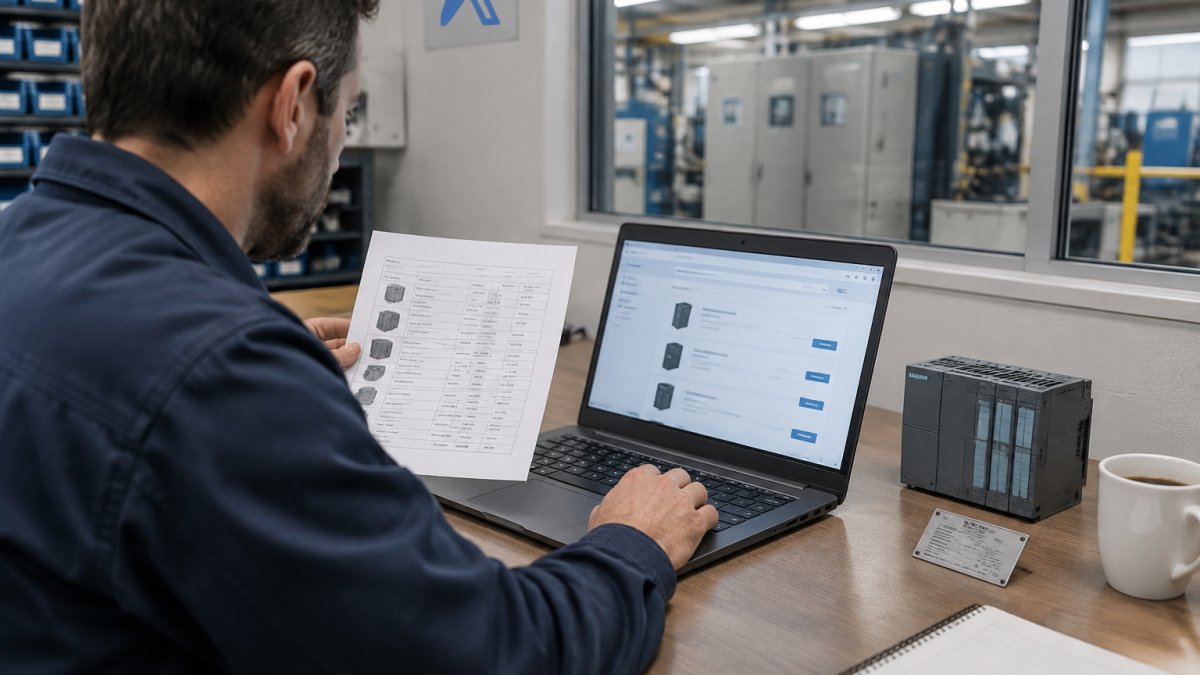
A parts marketplace finds and prices a specific part today; a data-cleansing tool repairs the material master record so the next search returns the right answer. Most MRO teams need both, bought at different moments.
In a marketplace, part identification serves a quote: you photograph a nameplate, the platform matches the MPN, and it returns offers. In a data-cleansing tool, an MPN match is used to merge duplicates, fill missing attributes and map a discontinued item to a successor.
Score any candidate on these criteria before you shortlist it:
| Evaluation criterion | Parts marketplace | Data-cleansing / master-data tool |
| Primary output | Live offers, availability, lead time | Deduplicated, enriched, successor-mapped records |
| Cross-plant duplicate detection | Not its function | Core function |
| Fit when a machine is down | Direct | Indirect, it prevents the next downtime, not this one |
Two trade-offs decide most evaluations. Time to value: a tool that needs a cleansing project before it returns anything is a different purchase from a marketplace answering a machine-down query. Scope of truth: a marketplace tells you what the market offers today, but not that the same servo drive is stocked under five descriptions across three plants, that only comes from reading the material master itself.
Check whether a nameplate match is made on the full manufacturer part number or on a partial or fuzzy string, since partial matches can return offers for the wrong variant.
If your bottleneck is a single part, a marketplace is the right tool. If your bottleneck is the BOM files behind a shutdown, cleaning and repricing BOM files is the practical route, and if you want both outputs from one pass over the export, MRO inventory optimisation is built to do that.
MRO Procurement Price Intelligence and Material Master Data Quality
Spare-part prices are rarely benchmarked, so the last purchase order price quietly becomes the reference for years; price intelligence is the practice of testing that reference against live market offers instead of a static catalogue. A golden record is the single, enriched, deduplicated version of a material master entry that all sites can trust.
The two are linked by one artefact: the material master export. In a typical SAP MM export, the fields that decide the outcome are the manufacturer part number (MPN), manufacturer name, material group, plant and storage location, unit of measure, last PO price and currency, moving average price, min/max or reorder point, and material status. If the MPN is buried in a free-text description field, matching degrades immediately.
A price-intelligence pass takes the MPN and manufacturer from the export, matches them against live supplier offers for the same part, and compares the result with the last PO price and the moving average price. Where the live offer sits materially below the reference, you have a benchmarking question; where the part returns no live offer at all, you have a lifecycle question.
A golden-record pass works on the same export but answers different questions:
- Duplicates: the same part under several material numbers, descriptions or units across plants, surfaced by matching on MPN and manufacturer rather than on description text.
- Enrichment: missing attributes filled from manufacturer data, lifecycle state, successor part number, key technical attributes.
- Obsolescence mapping: a discontinued item (for example a drive or PLC module the manufacturer has moved to a successor) mapped to its known replacement, so the next requisition points at a part that can actually be bought.
Use this checklist before you trust any golden-record output:
| Check | Why it matters |
| Is the MPN a dedicated field, or free text? | Free-text MPNs break matching |
| Are lifecycle states recorded? | Without them, obsolete parts look active |
| Are successors linked? | An unmapped successor sends the buyer back to search |
At Automa.Net, we read one material master export as it is, with no cleansing and no ERP integration, against live supplier offers. That single pass answers three questions: where you overpay, which parts are duplicated across plants, and which stock is idle. The MRO price-intelligence capability handles the first; the golden-record capability handles the second and maps obsolete parts to known successors. If idle stock itself is the problem, surplus asset recovery turns it back into working capital.
Confirm any merge on the full MPN and manufacturer before you retire a material number, since a golden record built on description text alone can merge parts that look alike but are not interchangeable.
The challenge is not finding another identification tool. It is proving, from data you already hold, where the money is leaking. Automa.Net reads your material master as it is and returns price intelligence, a warehouse golden record and surplus recovery from one export, priced per material record with unlimited users. Get started with Automa.Net and turn your existing export into three answers you can act on.
Frequently Asked Questions
What is Partium used for in industrial procurement?
Partium is used to identify industrial parts and pull together supplier information, mainly by matching part numbers and images to a catalogue. It helps buyers find sources for components that are hard to describe in words.
How does a Partium alternative differ from an industrial spare parts marketplace?
A data tool enriches and matches records; an industrial spare parts marketplace puts real, in-stock inventory from verified suppliers in front of you. The two answer different questions. If your problem is a machine down and the part not found, you need the marketplace. If your problem is the same servo motor under five descriptions across sites, you need the data side.
What should buyers check when evaluating an industrial sourcing platform?
Check whether it works with your material master export as it is or needs a cleansing project first, whether prices are compared against live offers or a static catalogue, and whether it shows several plants in one view. Also confirm how it is priced, where your data is hosted, and whether the supplier's condition, warranty and return terms are stated per offer.
Other Posts

Is the 6SL3120-1TE22-4AD0 Still Worth Sourcing?
The 6SL3120-1TE22-4AD0 is a 24 A SINAMICS S120 single motor module. Compare condition grades, verify nameplates and find verified stock fast.
Read More →
Is the 6BK1621-0AA00-0AA0 Still the Right Gateway?
The 6BK1621-0AA00-0AA0 links PROFINET to BACnet/IP. Compare specs and sourcing options before you specify or replace this Siemens module.
Read More →
Is Real-Time Inventory Tracking Worth It for Distributors?
Is real-time inventory tracking worth it for distributors? We weigh accuracy gains against cost, data risk and ROI workflows.
Read More →