7 Real Benefits of Sourcing Surplus Industrial Components

Sourcing surplus industrial components gives you verified stock that exists today instead of waiting on a future production run, so you can close the gap when an OEM quotes 20 weeks and your line stops in three. Surplus parts are unused or lightly used automation components from overstock, cancellations, plant closures or upgrades, priced below equivalent new units.
- Surplus means unused or lightly used parts; refurbished means repaired, cleaned and tested before resale.
- Match full part number, revision and firmware against your BOM before ordering any surplus unit.
- Request photos of the actual unit, provenance and written warranty terms before you approve the order.
- Bench-test every surplus part on arrival: power up, load firmware, verify I/O before installation.
- Surplus works best for non-critical spares and planned replacements, not critical safety stock.
Why a Discontinued Drive Puts Your Line at Risk
A Siemens drive goes end-of-life, and the OEM quotes 20 weeks. Your line stops in three. That gap is where sourcing decisions get made under pressure, and it is where most maintenance teams lose control of both budget and schedule.
The benefit of sourcing surplus industrial components starts here: verified stock that exists today, not on a future production run. For a plant spending 184,000 EUR a year on parts, shifting 30% of non-safety procurement to surplus can save between 36,800 EUR and 50,600 EUR annually, according to Platinum International's procurement analysis. That figure matters less than the mechanism behind it, which we will break down section by section.
What Counts as Surplus Industrial Components
Surplus industrial components are unused or lightly used automation parts that enter the secondary market through overstock, project cancellations, plant closures or upgrades. They are physical goods: PLCs, drives, HMIs, servo motors, sensors, contactors, power supplies.
They are not refurbished units, and they are not scrap. That distinction drives everything about price, risk and verification.
Where surplus stock comes from
- Machine builders holding spare stock from completed projects
- Plants that closed a line or standardised on a different platform
- Distributors clearing slow-moving inventory
- OEMs and integrators with cancelled-order material
Prices run well below equivalent new units, per Maas Companies' analysis of surplus procurement. The catch is provenance. You need to know which of those four sources a part came from.
The Cost Case: Acquisition Price, Working Capital and Cash Flow
Cheaper units are the obvious win. The bigger number sits in working capital and in the cost of not having the part.
Surplus procurement preserves capital and supports ESG goals by extending the lifecycle of existing industrial assets, as Maas Companies explains. Translation for a maintenance budget: money not tied up in safety stock stays available for the parts you actually consume.
Supply chain volatility adds pressure. Disruptions drive a 3-5% increase in expenses and a 7% decrease in sales, according to Procurement Tactics' 2026 supply chain statistics. Downtime from a missing drive is not a line item you can absorb.
The acquisition price is only the first line of the comparison. Landed cost is what you actually pay, and it includes freight, customs where applicable, incoming inspection time, any bench testing you cannot do in-house, and the risk-adjusted cost of a part that fails after installation. A surplus unit at a fraction of list price can still be the more expensive option if it arrives without test documentation and your team spends two shifts validating it.
Working capital works in the opposite direction. New OEM stock ties up cash in safety inventory that may sit for years. Surplus sourcing lets you buy against a specific failure rather than against a forecast, which releases capital for consumables, service contracts and the parts you turn over regularly. The trade-off is that you cannot rely on the same part being available next quarter, so surplus works best for non-critical spares and planned replacements, not for the safety stock you need on the shelf for a critical asset.
| Cost factor | New from OEM | Surplus verified | What to check |
| Unit price | List price | Below list | Condition and provenance |
| Lead time | Often 12-20 weeks | Usually in stock | Actual warehouse confirmation |
| Landed cost | Freight and duty only | Freight, inspection, possible testing | Who pays return freight |
| Working capital | Tied up in stock | Released | Storage and insurance cost |
| Obsolescence risk | Repeats at next EOL | Removed | Firmware and revision match |
| Warranty | OEM standard | Supplier-specific | Written terms before order |
| Failure risk | Low but not zero | Depends on provenance and testing | Test documentation and remedy |
Watch out: a low unit price with no written warranty and no test report is not a saving, it is an unquantified risk. Price the inspection time and the potential second purchase before you approve the order.
Surplus vs Refurbished Parts: What the Labels Actually Mean
The two labels get used interchangeably in listings. They should not be.
Surplus means the part was never installed, or was pulled from service with low hours. Refurbished means it was repaired, cleaned and tested before resale. Both can work. The risk profile differs.
Surplus carries uncertainty about storage conditions and firmware state. Refurbished carries uncertainty about the repair itself and who did it. Neither label tells you anything unless the supplier documents it.
If you are weighing the two for a specific asset, our guide on whether buying refurbished industrial electronics is worth it walks through the trade-offs.
Watch out: a listing that says "refurbished" without naming the test procedure or the repair scope is a label, not a specification. Ask for both in writing.
How to Verify Surplus Components Before They Reach the Panel
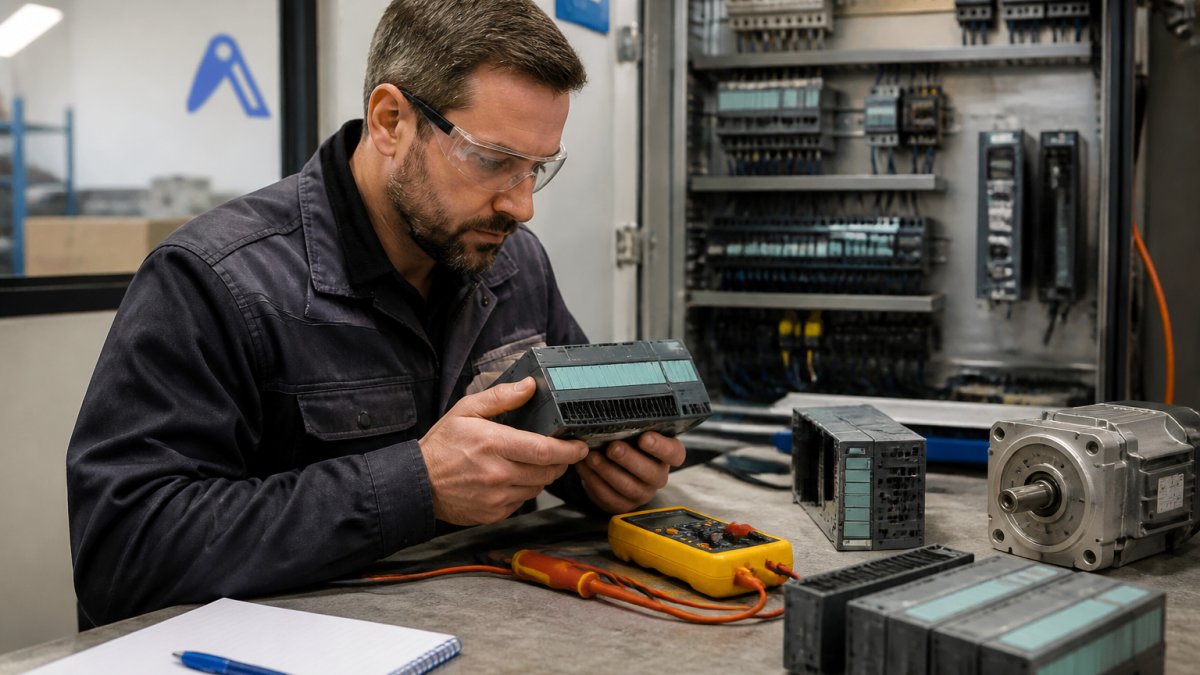
Verification is where most buyers underinvest, and where the real savings get protected. Run every part through the same sequence before it goes anywhere near a control cabinet.
Find it on Automa.Net →
- Match the nameplate data. Compare full part number, revision and firmware against your BOM. A single suffix character can change I/O count or protocol support.
- Request photos of the actual unit. Not stock images. Nameplate, terminals, housing condition.
- Ask for provenance. Original project, decommissioning date, storage conditions.
- Confirm test documentation. Bench test results, parameter backup where applicable.
- Check the warranty terms in writing. Duration, what it covers, who pays return freight.
- Bench-test on arrival. Power up, load firmware, verify I/O before installation.
Sourcing from unverified channels creates quality and compatibility risk, as Classic Automation notes on surplus sourcing. The human relationship with the supplier is part of the control.
Traceability is the part most buyers skip. Ask for the serial number and check it against the documentation the supplier provides. A part with no serial history and no decommissioning record is not necessarily bad, but you cannot treat it the same as one with a documented chain of custody. For safety-critical or life-limited components, surplus sourcing is usually the wrong choice unless the supplier can show a full test and calibration record.
Compatibility needs engineering sign-off, not just a part-number match. Revision changes can alter firmware behaviour, communication protocols and parameter sets. Where the exact revision is unavailable, an obsolete-part substitution may work, but it needs approval from the maintenance or engineering team who own the asset, not from procurement alone. Document that approval before the part goes on the panel.
Risk allocation is commercial, not technical. Confirm the return window, the warranty scope and the remedy for a nonconforming part before you order. A supplier who will replace a failed unit is worth more than one who will only refund the purchase price, because the replacement keeps the line running. Get those terms in writing and keep them with the part record.
When you need to identify a part from a nameplate photo before you can even search, AutomaSnap reads the label and gives you the part number to work from. That shortens the front end of the verification sequence and reduces the chance of ordering the wrong revision.
Finding Hard-to-Find Automation Components Without a 20-Week Lead Time
Hard-to-find is a search problem before it is a price problem. The part exists somewhere in the secondary market; the question is whether you can see it today.
Access to real-time inventory across diversified supply lines has become a competitive advantage, according to NewPower Worldwide's 2026 sourcing report. That is the whole game for legacy stock.
For obsolete components specifically, our guide on how to source obsolete industrial components covers the full workflow. When you need offers fast, the Request Board lets you broadcast an RFQ to the supplier network instead of emailing distributors one at a time.
A Surplus Parts RFQ Template That Gets Usable Answers
Most RFQs get vague replies because they ask vague questions. Use this template and you will get comparable offers.
Part number: [full OEM number, including revision suffix]
Description: [product family, e.g. PLC CPU module]
Quantity needed: [number]
Condition accepted: [new surplus / refurbished / either]
Provenance required: [yes/no, plus what you need documented]
Test documentation required: [bench test report / parameter backup / none]
Warranty required: [minimum duration and scope]
Delivery deadline: [date]
Ship-to: [site address]
Clean BOM data makes this faster. The BOM Repricer turns a messy parts list into structured lines you can send out directly.
Run Your Next Obsolete-Part Search Through AutomaSEARCH
The practical next step is one search, not a strategy document. Take the part number that has been sitting on your risk list and run it through AutomaSEARCH to see live stock across the supplier network.
Our 2026 guide to buying surplus industrial automation parts online covers how to evaluate what comes back.
Frequently Asked Questions
What are the benefits of buying surplus automation parts?
The main benefits are lower acquisition cost, faster parts availability and avoided downtime on legacy machines. Surplus equipment is generally priced below equivalent new units, and the saving depends on condition and provenance. Surplus sourcing also extends the lifecycle of existing assets and frees working capital tied up in safety stock.
Are surplus and refurbished industrial parts the same?
No. Surplus parts are unused or lightly used stock that was never installed, or was pulled from a decommissioned line and never repaired. Refurbished parts have been repaired, cleaned and tested, often with replaced components. Surplus carries the original manufacturer's build but no fresh warranty from the OEM; refurbished carries a repairer's warranty but a modified history. Ask the supplier which category a part falls into, and get the answer in writing on the quote before you approve the order.
How can you verify a surplus industrial component before purchase?
Request the nameplate photo, the exact order number and the firmware or hardware revision, then cross-check them against your BOM. Ask for a test report or a bench-test confirmation, and confirm the storage conditions. For drives and servos, check whether the unit was stored with its parameters intact. A photo-based check of the nameplate is the fastest first filter: AutomaSnap lets you identify a part from a nameplate image before you commit to an RFQ.
What risks should buyers consider when sourcing obsolete components?
The main risks are compatibility (a different firmware revision that will not run your program), unverified provenance, and no return path if the part fails on commissioning. Sourcing from unverified channels raises quality and compatibility risk, which is why supplier trust matters as much as price. Mitigate by buying from a verified supplier network, agreeing return terms in writing, and keeping a tested spare on the shelf for critical assemblies.
Your line will lose another legacy part this quarter. The question is whether you find out from a failure or from a search. Automa.Net connects you to real-time inventory from 700+ suppliers, with 14.8 million+ in-stock products and verified listings, so you can confirm availability before the machine stops. Get started with Automa.Net and source your next obsolete part from stock, not from a lead-time estimate.
Find it on Automa.Net →
Other Posts

SINAMICS S120 Double Motor Module: Which Variant Fits?
Choosing a SINAMICS S120 double motor module? Compare 5 A, 9 A and 18 A variants, part numbers and compatibility before you buy.
Read More →
HMI Touch Screen Not Working? Common Operator Panel Faults and Repair
Why HMI touch screens and operator panels fail, what to check first, which faults are repairable, and when replacing the panel makes more sense.
Read More →
Sourcing Hard-to-Find Allen-Bradley Drives: 7 Best Practices
Sourcing Allen-Bradley drives gets harder once a model is discontinued. Learn seven practices that shorten the path to a verified replacement.
Read More →