Sparetech Alternative for Maintenance Teams: Sourcing Guide

A sparetech alternative for maintenance teams is an industrial spare parts marketplace that gives you access to physical in-stock inventory across many suppliers, rather than another data-governance dashboard. Automa.Net lists more than 14.8 million in-stock products, so you search by part number once and compare real offers instead of calling suppliers one at a time.
- Data governance cleans records but does not create stock, so a clean part number can still return no part.
- AutomaSnap identifies a part from a photo of its nameplate to reduce part-number transcription errors.
- The Request Board broadcasts one requirement to many suppliers and collects replies in a single place.
- State the exact part number, quantity and whether refurbished units are acceptable, or offers cannot be compared.
- Test the model by posting one hard-to-find part on the Request Board and comparing replies to quotes you hold.
Why Maintenance Teams Outgrow a Data-Only Sparetech Alternative
A line stops at 06:40 because a drive module failed.
Data-governance platforms solve a real problem: cleaning and governing spare-parts master data so inventory records stop contradicting each other.
**A spare-parts data platform standardises material master records, classifies parts and flags duplicates.
Teams outgrow the data-only model for three practical reasons:
- The record is clean, but the part is still unavailable. Data governance does not create stock.
- Obsolete components fall outside standard catalogues, so classification work alone returns no sourcing route.
- Procurement still runs on email and phone calls, one supplier at a time, while the machine is down.
If your bottleneck is a missing Siemens module rather than a messy material master, you need a different tool category.
What an Industrial Spare Parts Marketplace Actually Delivers
An industrial spare parts marketplace delivers one thing software cannot: access to physical inventory held across many suppliers at once. Automa.Net connects a verified network of distributors, brokers and machine builders, with more than 14.8 million in-stock products listed, and lets you search by part number instead of calling each supplier in turn.
A supplier lists stock with a part number, condition and quantity. You search once and get matches from multiple holders, a comparable set of offers instead of five phone calls and three voicemails.
What this changes for a maintenance team:
- Parts availability becomes visible. You see whether a component exists in the network before you commit to a repair or a retrofit.
- Stockouts get an alternative route. When your own store is empty and the OEM lead time runs long, the network is the second tier of supply.
- Spend becomes comparable. Multiple offers on the same part number give procurement a real price reference rather than a single quote to accept.
How the workflow runs from breakdown to bench
The daily reality is a work order with a dead asset, a technician at the cabinet, and a buyer under pressure. A marketplace fits that loop in four steps:
- Identify. The technician photographs the nameplate. AutomaSnap identifies the part from a photo of its nameplate, which helps reduce transcription errors in part numbers.
- Search. The buyer runs the confirmed number through AutomaSEARCH and sees which network holders list it, in what condition, and in what quantity.
- Quote or order. If a direct match exists, the buyer compares offers side by side. If not, the requirement goes to the Request Board so holders can respond.
- Record. The chosen route, supplier and part number are logged against the asset so the next failure starts from a known position.
Identification is where the loop usually breaks. A base part number that omits the hardware revision can return offers for a module that will not seat in the backplane. The marketplace cannot fix a wrong number, so the nameplate step deserves the time.
What you need in place before the first search
A marketplace is not a data-migration project, but it does assume a minimum level of part-number hygiene. Before you rely on it for a live breakdown, confirm three things:
- Your BOM or asset register carries the full part number, not a truncated internal code. A description like "drive module" returns vague offers.
- You know which assets are critical. Sourcing effort should follow criticality, not volume.
- You have a named person who owns the RFQ. A request posted by nobody in particular tends to sit.
If your material master is the actual bottleneck, a BOM cleanup step comes first. The BOM List Cleaner and BOM Repricer help clean and reprice bills of materials, supporting more accurate searches for physical parts.
Where the model stops
The honest limitation: a marketplace is only as good as its supplier base. Coverage varies by brand and generation.
A second limit is condition. A marketplace shows you what holders list, not what your application tolerates.
For teams that want to understand how automated sourcing shortens the path from failure to replacement, our guide to reducing downtime with automated sourcing walks through the workflow in detail.
Obsolete Automation Parts Sourcing When the OEM Has Moved On
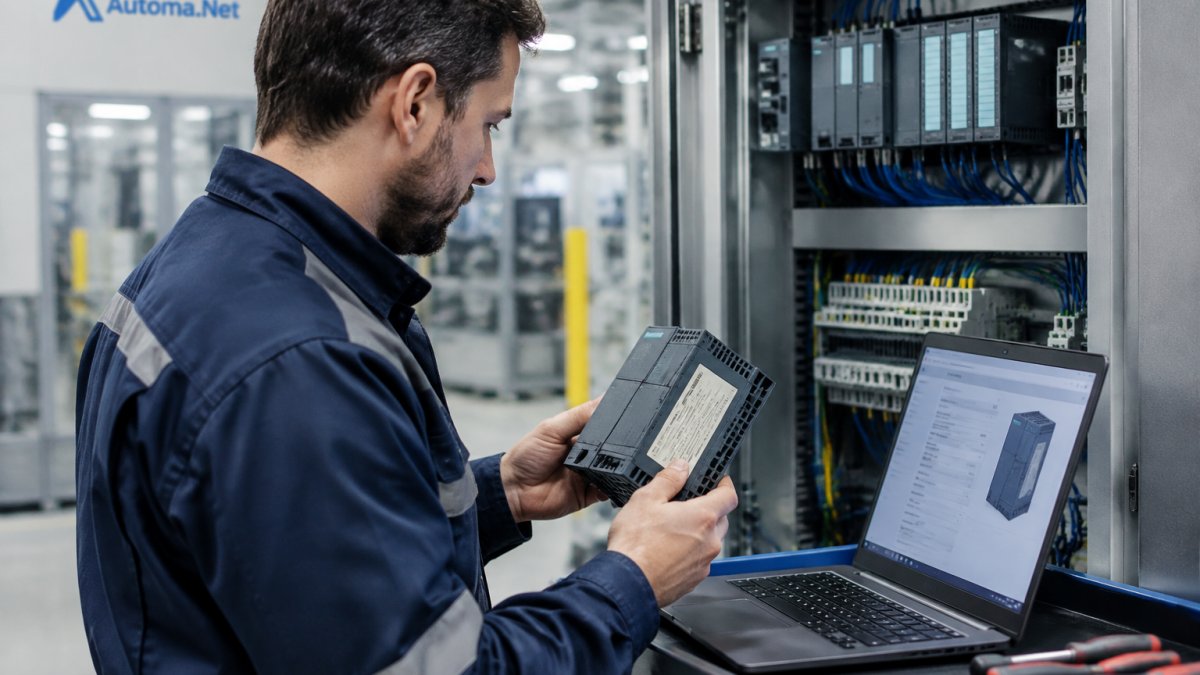
Start with identification, not search. Photograph the nameplate and record the exact part number, including any suffix that denotes a hardware revision.
Once you have the correct number, search across the network rather than a single distributor. Expect three outcomes:
- Stock exists. You get offers and compare condition and price.
- No direct match. A compatible successor or a refurbished unit may be the route.
- Nothing in the network. You post the requirement so holders can respond.
A common mistake is ordering on the base part number alone, which can result in a revision that does not fit the backplane.
For a deeper comparison of original versus aftermarket supply routes, our OEM vs aftermarket industrial parts guide covers the trade-offs in full.
How an Industrial Parts RFQ Platform Shortens the Sourcing Loop
The Request Board works exactly this way. You post the part number, quantity and any condition requirement.
Where the time actually goes in a manual loop:
| Stage | Manual approach | RFQ platform approach |
| Identify part | Read nameplate, retype number | Photo match against catalogue |
| Find suppliers | Call list one by one | One request to the network |
| Collect offers | Email threads, voicemails | Single response list |
| Compare terms | Rebuild from notes | Side-by-side view |
| Place order | Repeat by phone or email | Order from the platform |
The gain is not only speed. Parallel responses give procurement a price reference across holders.
A vague RFQ returns vague offers. State the exact part number, the quantity, and whether refurbished units are acceptable.
You can see how the process works and post a part requirement on the Request Board to test it against a live requirement.
OEM vs Refurbished vs Surplus Parts: A Sourcing Checklist
OEM, refurbished and surplus parts differ in origin, warranty and risk, and the right choice depends on the machine's criticality and remaining service life. There is no universal answer, but there is a repeatable decision process.
Use this checklist before you commit to a supply route:
- [ ] Confirm the exact part number, including revision suffix
- [ ] Establish whether the OEM still produces or supports the item
- [ ] Check the OEM lead time against your production schedule
The trade-offs in short:
- OEM new: highest certainty, longest lead time, highest cost. The default for critical assets still under support.
- Refurbished: tested original hardware, shorter lead time, variable documentation. Fits non-safety-critical applications where a known-good unit is acceptable.
- Surplus: genuine parts from overstock or decommissioned lines, often the only route for discontinued items. Condition and storage history need checking.
A common mistake is treating surplus as inherently inferior. Some surplus is original manufacturer stock that a plant bought and never used. The real risk is storage and handling history, not origin.
Comparing Sourcing Options: Features, Fit, and Total Cost
Sourcing options differ most in what they actually deliver: data, stock, or both. A data-governance platform and a parts marketplace are not substitutes, and treating them as such is where selection goes wrong. We compare them on the criteria that decide fit, and we add the implementation and migration detail that most comparisons skip.
| Capability | Data-governance platform | Parts marketplace |
| Clean material master | Core strength | BOM tools support it |
| Real in-stock inventory | Not offered | Core strength |
| Obsolete part coverage | Depends on catalogue | Network-dependent |
| RFQ to multiple suppliers | Not offered | Request Board |
| Nameplate identification | Rarely | AutomaSnap |
| Surplus stock recovery | Limited | Surplus Solutions |
| Implementation effort | Data migration project | Account setup |
| Ongoing effort | Classification and governance | Per-request sourcing |
| Integration with CMMS/ERP | Usually required | Optional, via part numbers |
What implementation actually involves
The matrix hides the part that decides most projects: effort. A data-governance platform is a migration project.
A marketplace is lighter to start but not effort-free. Setup is an account and a first search. The ongoing effort is per request: identifying the part correctly, stating condition requirements, and comparing offers.
Integration is the other hidden cost. A data platform usually wants to talk to your ERP or CMMS, which means a project with IT.
Selection guidance by operating context
There is no single right answer. The fit depends on where your sourcing loop actually breaks:
- Large plant with a messy material master and a dedicated data team. A data-governance tool earns its place. Keep it. Add a marketplace as the sourcing layer for the parts the clean data still cannot find.
- Team chasing obsolete parts weekly. The marketplace is the missing layer. Data quality is not your bottleneck; availability is.
- Small MRO team without a dedicated buyer. A marketplace with RFQ built in removes the coordination burden of calling suppliers one at a time.
On total cost of ownership
The calculation is not the licence fee alone. A data platform carries migration effort, classification work and ongoing governance. A marketplace carries transaction cost per order and the value of time saved in the sourcing loop.
The mechanism is simple. Every hour a critical asset sits idle is an hour of output you do not recover. A sourcing route that shortens the loop from days to a single request changes that number in your favour.
For a direct evaluation against another platform in this category, our Verusen vs Sparetech buyer's comparison sets out the criteria side by side. And if idle stock is part of your problem, Surplus Solutions shows how teams turn overstock into recovered value.
Start With One Part Number on the Request Board
The fastest way to test whether a sourcing marketplace fits your operation is to run one real requirement through it.
Here is how we would do it.
Get started with Automa.Net and put your hardest-to-find part in front of the network today.
A discontinued module should not decide your production schedule. Post the part number, compare the offers, and let the network carry the search.
Frequently Asked Questions
What are the best alternatives to SPARETECH for maintenance teams?
The right alternative depends on whether your bottleneck is data or physical parts. Data-governance platforms focus on cleaning and managing parts master data. A sparetech alternative built around physical sourcing, like Automa.Net, connects you to a network of distributors and brokers holding real stock, including obsolete PLCs and drives. Teams that lose production time waiting on a discontinued part usually gain more from a marketplace with live inventory and RFQ tools than from another data-cleansing layer.
Which platforms help find obsolete PLCs and automation parts?
Look for a platform with live inventory across many suppliers, not a single warehouse. Automa.Net focuses on obsolete and legacy automation components from brands such as Siemens, Allen-Bradley, ABB, Schneider, Fanuc and Beckhoff. AutomaSEARCH queries the network, and AutomaSnap identifies a part from a photo of its nameplate when the label is worn or the part number is unclear. That combination matters when the OEM has discontinued the module and you need a verified alternative quickly.
How can buyers compare OEM, refurbished and surplus automation parts?
Compare on four points: traceability, test evidence, warranty terms, and lead time. OEM parts carry full documentation but often long lead times on legacy items. Refurbished parts should come with a test report and a defined warranty. Surplus stock is genuine but may have been sitting in another plant's warehouse, so ask for storage conditions and photos. Use a checklist and confirm the seller's return policy before committing, especially for high-value drives and servo motors.
What information should an RFQ include for a hard-to-find spare part?
Include the exact part number and any suffix variants, the machine or line it sits on, the quantity needed, and your required delivery date. Add a photo of the nameplate and the surrounding installation if the label is damaged. State whether refurbished or surplus is acceptable and what warranty you require. On the Request Board, this detail lets suppliers respond with a specific offer instead of a generic quote, which cuts the back-and-forth and gets a usable answer faster.
Other Posts

FANUC Servo Motor Repair vs Replacement Cost Analysis
Weigh servo motor repair against replacement for FANUC robots, including lead times, refurbished exchange options and the true cost of downtime.
Read More →
7 Ways to Buy Discontinued Siemens PLC Parts
Buying discontinued Siemens PLC parts? Compare 7 sourcing routes and verify condition before you commit.
Read More →
How to Fix Excess MRO Inventory Before It Ties Up Capital
Excess MRO inventory ties up working capital in parts you may never use. Learn how to separate safety stock from surplus and cut stock safely.
Read More →